BREAK YOURSELF OVER YOUR KNEE:
On Viktor Shklovsky, Zoo, and the Adventures of Russian Formalism
Daniel Berchenko
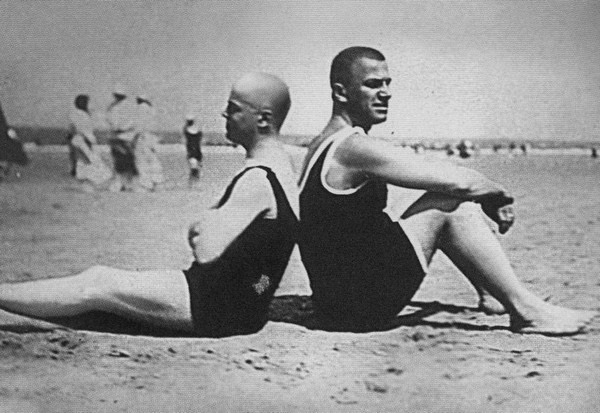
Shklovsky and Mayakovsky on the beach in Norderney, 1923
In 1922, Viktor Shklovsky was heartsick and on the run. Or he’d been on the run, after finding out that the Cheka was waiting for him at his house in St. Petersburg, and then he washed up in Berlin, where all the best Russian exiles were washing up that year. While there he’d become reacquainted with and obsessively attached to Elsa Triolet, another Russian émigré, who liked him, but not in that way. (It’s unclear how Shklovsky’s wife felt about this situation—the Cheka had thrown her in prison when he fled.)
Shklovsky was 29 and had established himself almost 10 years earlier as a kind of theorist of Russian Futurism. He’d met Mayakovsky and Khlebnikov at a cabaret in St. Petersburg when he was still a student and gave a famous speech there where he said things like, “The task of Futurism is to resurrect objects, to restore to man his ability to sense the world.” In 1916, he’d founded Opoyaz, the Society for the Study of Poetic Language, which had become one of the centers of the critical movement known as Russian Formalism.
The war and revolution and civil war had derailed him a bit. He fought in Galicia in an armored car unit, ran amok in the streets of St. Petersburg during the February revolution, and served as a commissar in Russian-occupied Persia, going to Opoyaz meetings and writing reports on the state of poetic language in between.
In Berlin he was basically at the height of his powers. He was getting ready to publish Sentimental Journey, his incredible novel-as-memoir about his adventures and misadventures during the revolution and civil war (which he claimed to write in 10 days), and also a collection of essays and a book of film theory. He was also writing The Theory of Prose, his critical magnum opus.
Elsa Triolet didn’t care about any of that. She wanted him to stop writing her letters. She told him that if he had to write, he couldn’t mention love. And this injunction, like an Oulipoian constraint, and the resulting letters, somehow collided with a series of essays he was writing about Berlin, and vignettes of Russians in Berlin, and his ongoing research for The Theory of Prose, to produce his next novel, Zoo, Or Letters Not About Love.
It’s hard to say what Zoo actually is. It presents as an epistolary novel, but the letters appear to be real, and some were written by Elsa—though in the book her name is changed to Alya. The title refers to the Berlin Zoo (the Russians in Berlin are caged animals, get it), and, obliquely, to the district around the zoo, which was the Russian émigré quarter at the time.
The first letter is from Elsa to her sister Lili Brik, who had probably introduced her to Shklovsky back in Petersburg in the 1910s. (Lili was married to Opoyaz member and Futurist impresario Osip Brik, but was also Mayakovsky’s mistress, and the three of them—Lili, Osip, and Mayakovsky—formed something like a Futurist power throuple.) In the letter, Elsa complains, “[Shklovsky] writes me one or two letters every day, brings them to me himself, then dutifully sits down beside me and waits for me to read them.”
The next two letters are an exchange between Shklovsky and Elsa. He tells her, “You are the city I live in; you are the name of the month and the day.” And, “I have wound my whole life around the thought of you.” And, “In Russia I was strong; here I have begun to weep.”
She says, “Don’t make wild scenes on the telephone. Don’t rant and rave. You’re managing to poison my days.” And we see where she’s coming from.
But from there Zoo spirals out into what I think of as Zoo. Shklovsky sends Elsa an ode to Khlebnikov, who died the previous year, mixed up with reflections on the role of the weather in Peter’s denial of Christ. He sends her barbed portraits of fellow Russian writers and émigrés like Boris Pasternak, Andrei Bely, and Roman Jakobsen, and also of less well-known publishers, painters, and aspiring poets. He complains about Berlin and the weather in Berlin and the miseries of exile.
Elsa, meanwhile, tells him about her time in Tahiti—she had lived there for a while with her now-estranged French husband. She tells him that she’s going dancing (but not with him), and thanks him for the flowers he’s constantly sending her. And she tells him again and again to lighten up. A masterclass in friendzoning from one of the greats: Elsa had at this point already successfully sidelined Jakobsen, Mayakovsky (setting him up with her married sister), and her own husband. (She did eventually succumb to the charms of Louis Aragon, whom she married in 1939 and fought with in the French Resistance.)
Then Zoo becomes something else again, turning inward and attempting to theorize itself. Epistolary autofictional ouroboros.
“There are two attitudes toward art,” Shklovsky writes in letter 22:
“One is to view the work of art as a window on the world. Through words and images, these artists want to express what lies beyond words and images. Artists of this type deserve to be called translators. The other type of attitude is to view art as a world of independently existing things. Words, and the relationships between words... these are the content of art. Art, if it can be compared to a window at all, is only a sketched window.”
This is the basic Formalist position Shklovsky was developing in Theory of Prose—an insistence on what Khlebnikov called “the self-sufficient word” and an opposition to literature as representation, an opposition to realism in the conventional sense. It draws its energy from the same impulses as Zaumism and Futurism, its poetic brothers in arms, dwelling in the phonic and linguistic building blocks of literature and their relations, rather than in what they signify.
Shklovsky describes this disposition, and the aesthetics it prescribes, in Theory of Prose:
“The path of art is a tortuous path, on which your feet feel each stone, a path that winds back and forth. Word goes together with word, one word rubs against the other like a cheek against another’s cheek. Words are separated from words, and instead of a single complex, an automatically pronounced expression that shoots out like a chocolate bar from a dispenser, there comes into being a word as sound, a word which is purely articulated movement.”
The metaphor of the vending machine is telling. The Futurists wanted to use the materiality of words to break the reification of language. Futurism fed off the general sense of the exhaustion of older forms that seemed to set in everywhere in Europe around 1910 (or that Cubism made everyone aware of then): the sense that they were no longer adequate to new realities—to modernity, or, some might, say the near-total penetration of the commodity economy into daily life. The sense that even language had become ready-made and needed to be destroyed and reconstituted.
Shklovsky and his Opoyaz collaborators saw this impulse as the driving force of literary history in all ages. “In order to restore the sensation of life, in order to feel things—to make a stone stony—we have something called art.” This is where that other key Formalist concept comes in: estrangement, ostrenenie. Art proceeds by taking the tired and familiar and making it visible again—an ultra-realism, not dissimilar to the strategies developed by the Surrealists a little later.
And so in Zoo, back in letter 22, Shklovsky sketches a little history of the novel leading up to (but not culminating in) Zoo: the emphasis on discrete episodes in the early novel, the rise of the psychological novel and an interest in the “connective tissue” between the individual elements, the estrangement of and experimentation with psychological motivation in the modern novel (for him Stendhal, Tolstoy, Dostoevsky).
“Finally, all contrasts are exhausted. Then one choice remains—to shift to the components, to sever the connections, which have become scar tissue. The most vital genres in contemporary art are the collection of articles and the variety show, which depends for its interest on the individual components, not on the connective tissue.... A more interesting case is the book which I am currently writing. It is called Zoo.... There the individual components are connected; in fact, everything is tied together by the history of a man’s love for a woman. This book is an attempt to go outside the framework of the ordinary novel. This book is being written for you, Alya; writing it is physically painful.”
Formalism is a dialectical theory, a theory of change, but not a materialist one: the medium in which literature develops and reacts and articulates itself is literature. The agent of change is literature itself. Shklovsky famously says elsewhere, “Art was always free of life, and its color never reflected the color of the flag that waved over the fortress of the city.”
This gets at one of the great mysteries of Shklovsky and his novels: what does it mean to offer a book of real letters by and about real people at a vexed historical juncture, or a memoir about the Russian Revolution, as “free of life”—“a world of independently existing things”?
After scoffing at previous critics’ attempts to treat golden age Russian literature as the product of social crisis, Shklovsky lashes himself to the mast of art for art’s sake at the exact moment when Russian literature really demonstrably becomes the product of social crisis, and then writes two “novels” documenting his own experiences during this crisis.
Some of Shklovsky’s efforts to banish politics from art, and criticism, might be due to his own ambivalence toward the revolution. It’s often said that he was a Socialist Revolutionary, and I’m sure that’s true, but it’s also a little unclear what it means in his case. The SRs were an agrarian socialist party who before the revolution (and after) were most well-known for assassinating high-profile government officials. They were the majority party in the short-lived provisional government, and in the even shorter-lived Constituent Assembly. They were not very ideologically unified, and Shklovsky was not a big ideology guy anyway. But this is a journal of historical materialist aesthetics so we need to know where we stand.
When he returned to St. Petersburg from Persia in early 1918, Shklovsky was incensed by the Bolsheviks’ dissolution of the Constituent Assembly and—apologies to true Leninists everywhere—plotted with some others (mostly SRs) to seize an armored car division and violently overthrow the Bolshevik government. The plot went nowhere and was eventually uncovered, and Shklovsky fled. His friend Gorky negotiated his return and exoneration in late 1918, and afterward Shklovsky worked with the Bolsheviks on various commissions, fought some Whites, ate frozen potatoes and dubious horsemeat like everyone else in Petersburg in those years, burned books and furniture to stay warm, wrote articles and went to meetings, and generally got on with his life.
Then in 1922, Shklovsky’s insurrectionary plot came up again as the Bolsheviks were preparing to put the SR leadership on trial. Gorky wasn’t around to help. Shklovsky escaped to Finland before he could be arrested and from there he went to Berlin, to be persecuted by Elsa Triolet.
While licking his wounds in Finland, Shklovsky wrote, “Of course, I’m not sorry that I kissed and ate and saw the sun. I’m sorry that no matter how hard I tried to direct events, they went their own way.... I should have probably let the revolution go past me.” But Shklovsky wasn’t finished with the revolution and the revolution wasn’t finished with him. The last letter of Zoo is addressed to the All-Russian Central Executive Committee. In it, Shklovsky says “I raise my arm and surrender” and asks to be allowed to return to Russia, adding, “The revolution transformed me; I cannot breathe without it.”
It’s an open question—for us, but even at the time for Shklovsky I think—whether he couldn’t breathe without the revolution or whether he couldn’t breathe without Russia. He was obviously miserable in Berlin, and his efforts to negotiate his wife’s release from prison from afar had been ineffectual. But also, his deeply ingrained iconoclasm and fetishization of the new made him want to be part of Russia’s rebirth, rather than stranded in dying postwar Germany, away from the action. I think he was always a little jealous of Mayakovsky, who Shklovsky at one point says “entered the revolution as one would enter his home.”
In any case, the request was granted. On his way to Moscow he met up with Mayakovsky on Norderney, an island off the German North Sea coast, where they presumably consoled each other over their troubles with their respective sisters and maybe complained about the NEP and the fate of the novel in the age of the modernist fragment, when connections have become severed and, as someone would later say, the whole is untrue. Looking back on the trip nearly 20 years on, after Mayakovsky’s death, Shklovsky wrote, “By that immense, alien sea, with its lip-cutting wind, our youth was ending.”
Back in Russia, the fortunes of Formalism were changing. What began as a minor revolt against the late imperial critical establishment had become a dominant force in Soviet letters. Opoyaz continued to meet and publish and expand, and Formalists were also moving into key academic posts. One critic wrote in 1922, “There is nowadays hardly a town in Russia that does not harbor at least one Opoyaz member.”
Formalism existed before the revolution but was in no way independent of it, in spite of Shklovsky’s protests. Nearly to a man, the early Formalists participated in the creation of the Soviet state and the wild ideological debates around the development of a new and truly proletarian art. Formalism’s emphasis on making and technique, as seen in titles of papers like “How Gogol’s Overcoat Is Made,” “How Don Quixote Is Made,” “How Verses Are Made,” and in key concepts like “baring the device,” seemed to rhyme with Constructivism and other trends in early Soviet aesthetics. Osip Brik—who, with Lili, went so far as to join the Cheka in 1920—wrote in 1923 that Opoyaz should be seen as “the best educator of the young proletarian writers.”
Shklovsky was less convinced that historical materialism was the best educator of young literary scholars. Marxism inquired into the laws of development of society; Formalism inquired into the laws of development of literature. Some Formalists were willing to admit that there might be a relation between the two, but efforts to determine what exactly that relation is devolved into scholastic base-superstructure-type disputes and maybe, Shklovsky said, it was best for everyone to stay in their respective lanes.
This attitude, and Shklovsky’s tendency to make glib pronouncements (“We are not Marxists, but if that utensil should prove useful in our household, we will not eat with our hands out of spite”), and, again, the growing influence of Formalism generally, eventually provoked a reaction. The Formalist Thermidor began, not quite by accident but maybe a little incidentally, in 1924 with the publication of Trotsky’s Literature and Revolution—a book that charts the course of Russian literature since the revolution, in an effort to attempt to begin to imagine what a properly Soviet literature might look like.
Somehow, in between suppressing Kronstadt and trying to outmaneuver Stalin, Trotsky had taken onboard a surprising amount of Futurist and Formalist output of the previous 10 years. He has measured praise for the Futurists (“Though remaining, in some respects, a Bohemian revolutionary off-shoot of the old art, Futurism contributes to a greater degree and more directly and actively than all other tendencies, in forming the new art”). And Shklovsky even gets a few pats on the head in passing: “Owing to the efforts of Shklovsky—and this is not an insignificant virtue!—the theory of art, and partly art itself, have at last been raised from a state of alchemy to the position of chemistry.”
But then he lets the reader know what he thinks of chemistry:
“The formalists are not content to ascribe to their methods a merely subsidiary, serviceable and technical significance—similar to that which statistics has for social science, or the microscope for the biological sciences. No, they go much further. To them verbal art ends finally and fully with the word, and depictive art with color. A poem is a combination of sounds, a painting is a combination of color spots and the laws of art are the laws of verbal combinations and of combinations of color spots.”
This is a charge that had been leveled at the Formalists, somewhat unfairly, for the previous few years: in their efforts to put literary theory on scientific footing, in their reliance on the adjacent field of linguistics, they had reduced its scope, according to Trotsky, “to an analysis, essentially descriptive and semi-statistical, of the etymology and syntax of poems.” In other words they were guilty of a kind of crude empiricism. (“An apparent objectivism based on accidental, secondary and inadequate characteristics leads inevitably to the worst subjectivism.”)
But the heart of Trotsky’s critique is a more or less common-sense attack on the Formalist conception of the autonomy of form:
“The form of art is to a certain and very large degree, independent, but the artist who creates this form, and the spectator who is enjoying it, are not empty machines, one for creating form and the other for appreciating it. They are living people, with a crystallized psychology representing a certain unity, even if not entirely harmonious. This psychology is the result of social conditions. The creation and perception of art forms is one of the functions of this psychology. And no matter how wise the Formalists try to be, their whole conception is simply based upon the fact that they ignore the psychological unity of the social man, who creates and who consumes what has been created.”
You can see Trotsky gesturing at problems that would occupy Marxist aesthetic theory for the next century and counting: social conditions... psychology... form. Just because we can’t specify exactly how they mediate each other doesn’t mean that they don’t. We can all agree that they do.
Even Shklovsky seemed to agree. When Theory of Prose finally appeared in 1925, it came with a preface that begins:
“It’s perfectly clear that language is influenced by social relations.... I examine in literary theory the inner laws of literature. If I were to draw a parallel with the factory, I would say that I am neither interested in the international cotton market nor in the politics of trusts, but only in the types of thread and the ways of weaving.”
He almost seems to be replying directly to Trotsky. Form mediated by social relations, okay. But crude empiricism: not guilty. Shklovsky himself happens to be interested in plot devices, motifs, and stepped structures, but others are free to study... whatever the international cotton market of literature is.
I don’t think Shklovsky is being disingenuous here—I think he’s expressing something he believed all along, but had maybe previously downplayed a bit for dramatic effect. Around this time, early Formalist apostle Boris Eikhenbaum would write, “Many of the tenets laid down by the Formalists in the years of bitter struggle with our opponents were not so much scientific principles as slogans paradoxically sharpened for propaganda purposes.” Roman Jakobsen later recalled that Shklovsky admitted to him, in private conversation, to going a bit too far with the whole “art was always free of life” thing, saying, “There is no harm in overstating the case, since one never gets anyway everything which one asks for.”
But harm had been done. Symposia on Marxism and Formalism were organized; the likes of Bukharin and Lunacharsky went on the attack. Lunacharsky wrote, “Before October, Formalism was a vegetable in season. Today it is a stubborn relic of the status quo, the last refuge of the unreconstructed intelligentsia, looking furtively toward bourgeois Europe.”
Some of those involved (along with Shklovsky, Brik, Mayakovsky, and others) with LEF, the journal of the neo-Futurist Left Front for the Arts, attempted various types of Marxist-Formalist synthesis. A “formalist-sociological method” was floated by one Boris Arvatov. Eikhenbaum sketched a theory of “literary mores,” which sees the relation between form and the larger social forces of production mediated by the writer’s position within the publishing marketplace. Marxist critics, however, tended to view this work as sociological dilettentism—an unwelcome incursion onto their turf by effete literary scholars.
By the time Shklovsky published Third Factory, a collection of autobiographical essays, in 1926, he’d begun to sound like a hunted man—a role he seemed to like, if we’re being honest. It features pieces with titles like “I Write About How Objective Reality Determines Consciousness, While the Conscience Remains in Disarray,” “A Case Ineptly Pleaded by Me,” and “What They Are Making Out of Me.” He ruminates on Lunacharsky’s metaphor, imagining the Formalists as aging vegetables that have been turned into soup:
“The earthquake is over. The lid is off, the soup has come to a boil, the spoons have been distributed. ‘Help yourself,’ they say. We have the right to refuse spoons. We are, after all, the ‘ideological superstructure.’ The connection between us and the soup is complicated and non-functional.... On the whole we probably were vegetables.... And I—gazing at samplers from Turkestan, stuffing silk pillows behind the couch, smudging the upholstery with my leather pants, devouring everything on the table—I was cooked along with the others at the Briks.”
You get the sense that, at the end of it all, being a vegetable out of season was a fate worse than death for the avant-gardist in his early 30s.
Shklovsky in the late ’20s was ruminating, but he was also still adapting and developing his theories—adapting rather than capitulating. In Third Factory he writes:
“At the moment, there are two alternatives. To retreat, dig in, earn a living outside literature and write at home for oneself. The other alternative is to have a go at describing life, to conscientiously seek out the new society and the correct world view. There is no third alternative. Yet that is precisely the one that must be chosen. An artist should avoid beaten paths.”
He tried. In 1928 he published his first real historical study, Materials and Style in Lev Tolstoy’s War and Peace, his own attempt at socio-formalism. It looks at how the formal demands of the novel mediate, and in fact compromise or run counter to, Tolstoy’s ideological defense of the decaying landed nobility (of which he was a member) of late-19th-century Russia from the rising threat of the radical intelligentsia—suggesting that War and Peace is radical in spite of itself.
The book, like everything else Shklovsky published in this period, was savaged by critics. His efforts to broaden the Formalist method to account for the impact of class conflict on form (and vice-versa) were seen as disingenuous—just another feint, they said, like his surrender in the last letter of Zoo. One review was titled “Belated Discoveries, or How V. Shklovsky Got Tired of Eating with His Bare Formalist Hands and so Supplied Himself with a Homemade Marxist Spoon.”
In early 1930, Shklovsky tried again to reframe his past and current thinking, without betraying it, in terms that would be acceptable to the increasingly hardline Soviet literary establishment. He published an article titled “A Monument to Scientific Error” (a reference to a novel by Jules Romains) in which he argues that his critics misapprehend Formalism because they focus almost exclusively on the work done by Opoyaz in its early years—what Eikhenbaum called “the years of bitter struggle with our opponents.” (This argument is basically correct in Trotsky’s case.) Shklovsky sees that work as a series of experiments in the pursuit of a method, a kind of phenomenological bracketing of extra-aesthetic factors necessary to put Formalism on scientific footing, and since left behind.
“Our first studies aimed to create a typology and morphology of the literary work. This type of work was necessary in the initial stages of the scientific study of literature, but it was not sufficient, as it was not even the anatomizing of literary works, rather the protocol of their disclosure. The abstraction of the literary system from other social systems was a working hypothesis that was useful for the initial accumulation and systematization of facts.”
He admits to himself hypostatizing this methodological principle at times, even as he tried to move beyond it. (“This transition was not easy and the old construction recurred in a variety of ways.”) And he’s explicit about his position ca. 1930: “Formalism is a trodden path for me, a path along which I have already passed and left several stages behind.”
Note the echo with the passage in Third Factory: the artist should avoid beaten paths. Later in that book he exhorts himself, “Change your biography. Make use of life. Break yourself over your knee.”
Shklovsky was always trying to break himself over his own knee. He was a wild man, a brawler (verbal and otherwise), a wit, a cabaret habitué—an unlikely leader of a school of scholarly criticism. He was anything but constant.
“Monument” wasn’t any more well-received than Shklovsky’s earlier attempts at conciliation, with one critic suggesting that Shklovsky should be put in front of “an ideological firing squad”—often a precursor to being put in front of the real thing a few years later. Who knows where it would have all went if Mayakovsky, under circumstances that remain mysterious, hadn’t died by suicide months after the article was published.
The shock of Mayakovsky’s death seemed to produce a kind of détente between Shklovsky and his enemies, and Shklovsky—incredibly for someone who did plot to overthrow the Bolsheviks and was the leader of an at-times avowedly anti-Marxist school of literary criticism—survived the ’30s in Moscow. He continued to work, somewhat in the shadows, never on beaten paths, into his 80s.

Still from Agnes Varda's Elsa la rose
SOURCES
Erlich, Viktor. Russian Formalism: History–Doctrine. Yale University Press, 1955.
Shklovsky, Viktor. Mayakovsky and His Circle. Translated by Lily Feiler. Dodd, Mead & Co., 1972.
Shklovsky, Viktor. “A Monument to Scientific Error.” Translated by Shushan Avagyan. Context, No. 24 (2014): 38–39. https://www.dalkeyarchive.com/2014/04/17/monument-to-a-scientific-error.
Shklovsky, Viktor. On the Theory of Prose. Translated by Shushan Avagyan. Dalkey Archive, 2021.
Shklovsky, Viktor. A Sentimental Journey. Translated by Richard Sheldon. Cornell University Press, 1970.
Shklovsky, Viktor. Third Factory. Translated by Richard Sheldon. Ardis, 1977.
Shklovsky, Viktor. Zoo, or Letters Not About Love. Translated by Richard Sheldon. Cornell University Press, 1971.
Trotsky, Leon. Literature and Revolution. Translated by Rose Strunsky. International Publishers, 1925.
Daniel Berchenko is a writer and editor living in Asheville, N.C.