AGAINST TRANSPARENCY:
Iran and the Psychic Cost of Unveiling
Rida Fathima
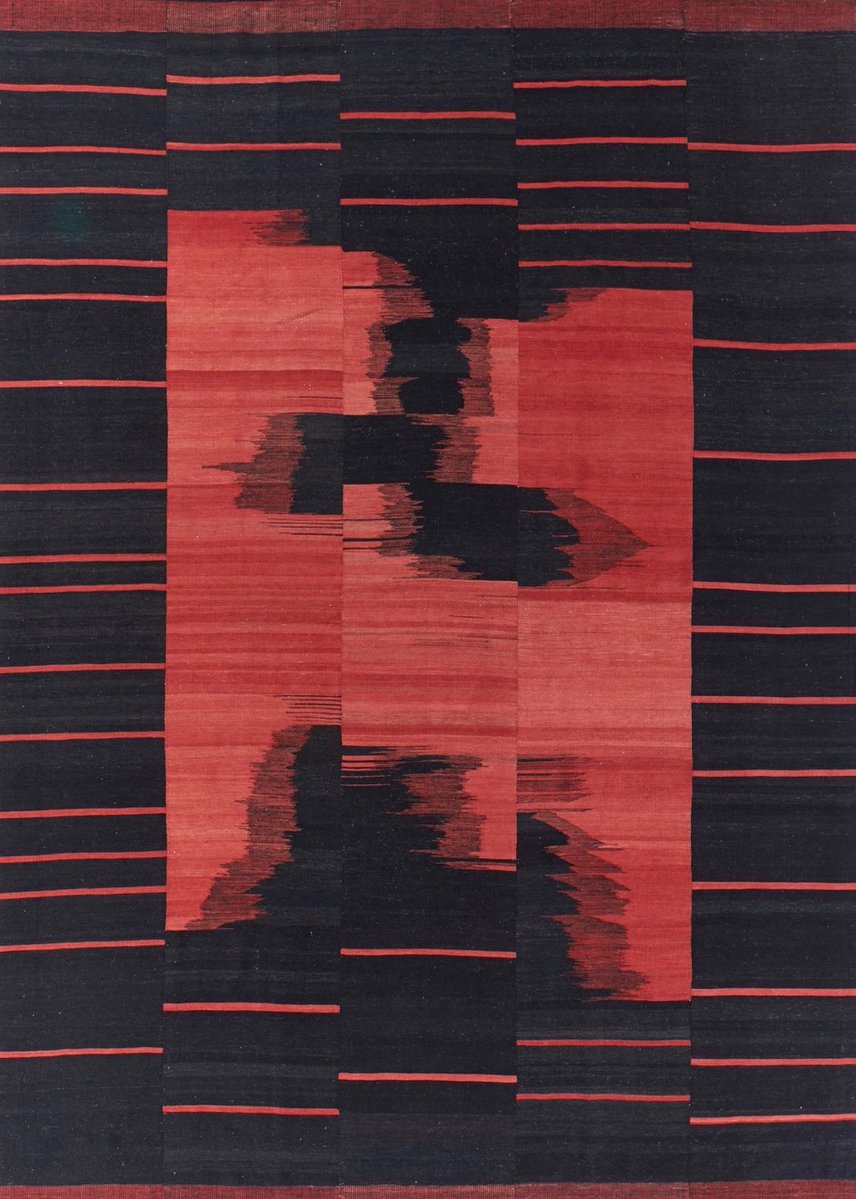
Iranian Rug from Alasht, via Edelgrund
The assassination of Ayatollah Khamenei and the joint US-Israel offensive against the Republic's people have stabilized and consolidated the fraying Iranian masses. Amid this unfolding consolidation, sprawled across months, several women dissenters have taken to the streets, declaring their support to the Republic in a time of crisis, ecocide and ruin. Suspending the domestic precarities that have cyclically plagued a sanctioned Iran, they have disavowed a liberation delivered by the US-Zionist nexus. Set against the longue durée of Woman, Life, Freedom and its global afterlife, this episode is instructive in rupturing the specter of the Iranian woman in the dizzying mediatization of Anglo-European reception, particularly as the emancipatory salve from the Republic.
The preceding events of the bread riots of 2026 and its subsequent discursive disappearance is crucial in unfolding this juncture. Bread––its shifting local subsidy policies and surging inflation under the strains of US sanctions––has historically fueled economic and civil unrest in the Republic. Shortly after the nation-wide protests following the riots that triggered mass unrest in Iran, the issues of bread disappeared from the reporting lexicon. The language of women's rights presented itself again, as it does, cyclically instrumentalized whilst making itself disposable in moments of imperial sanctions, economic choke points and mass death delivered by US-made bombs. The scene is set in the capital of Iran.
On the 28th of February, while the totalizing shadow of terror engulfed the state, the assassination of the supreme leader with several other high military officials in succession birthed an interregnum of frayed subjectivities outside Iran. In the first world, in the predominantly Iranian and Jewish borough of London, Finchley, a perverted spectacle was afoot. On the first of March, the Times of Israel reported that Iranians and Jews were found celebrating the ayatollah's death shoulder to shoulder in the streets of North London. It is not an uncommon sight in the global cities across the world to chance upon the warped flags of the Shah enmeshed with the blue and the white of the Israeli ethnostate, but this particular moment of patricide delivered externally through the US-Zionist nexus was a moment of revolutionary shame and jouissance for the deserters of the regime, ecstatic to usher in the new father figure, the son of the Shah himself.
Meanwhile cutting across the aspirations of its externalized reactionary milieu, for the first time in years, in devastating the military assets and the global checkpoints of finance and oil across the Middle East, the Islamic Republic of Iran (IRI) broke away from its long-standing position of evading prolonged confrontation and asymmetric warfare. If the world order today is demarcated between the before and the after of October 7 (and now, the blockade of the Strait of Hormuz and Ansarallah’s capture of the Red Sea), then the lexicons of revolutionary and counter-insurgent language have come to meet in the present age of a dismantled world-system, forever altered by the black rain cast across West and South Asia. The Islamic Republic of Iran has found itself at a crucial juncture in its fight for sovereignty and the survival of the 'Axis of Resistance'. The counterinsurgent deployment of the veiled woman has come to animate discourses across the spectrum with a renewed urgency.
Frantz Fanon's most profound thesis on the veiled woman appears in the last few pages of “Algeria Unveiled.” He writes with a frustration at colonial incomprehension of the veil's metamorphosis––from a rigid separator of the sexes to its subsequent abandon in the face of revolutionary action––concluding that the foundation of all scientific field studies encapsulating Muslim society and the mystified infantile Muslim women have been challenged, singlehandedly, by the experience of revolution. The betraying mystification and the simplicity of the violent gaze appearing in the appendix of the chapter is testament to the world we occupy today in the aftermath of October 7th. The soundscape of embedded feminism reverberating through Tehran, in anticipation of the colonial encounter reproducing itself in the total situation of revolution, would seem adequately prophetic. The following is an attempted Fanonian reading of this unfolding register of imperial diasporic modernity and ruin, critically litigating the question of the veil and empire in the Islamic Republic.
In Iran, a mixed array of signals reverberated through the capital and its military hinterlands. As 200 Israeli fighter jets and ballistic missiles rained down, subsuming life and infrastructure, civilians were being asked to evacuate, lest they were to become human shields for the Islamic Revolutionary Guard Corps. The contagion of voices that sought to cut through the noise of explosions and aerial strikes in perpetuity is reminiscent of the series of Israeli leaflets issuing warnings, threats, and orders of evacuation dropped in Gaza, Syria, and Southern Lebanon. The leaflets dropped in Beirut offered a chilling reminder of Israel’s success in Gaza, urging the bombed bodies of the state to disarm Hezbollah. This threat to the axis has come to fruition in the 12 Day War and the subsequent bombing of Iran, producing a legion of paraded Zionist victories that serve as ideological crutches for the next. For the diaspora stationed in the outposts of the first world, however, all bombing and death is interregnum. Despite the Trump administration’s vociferous abandonment of Reza Pahlavi, its thwarted aspirations to negotiate with Iranian insiders in the face of the Hormuz blockade, and US-Gulf capital disintegration, the diaspora continues to hold out hope for totalizing collapse.
A substantial foundation of this hope is rooted in a new climax to the Zan, Zendegi, Azadi (Women, Life, Freedom, or WLF) movement1. Consider a Guardian interview with the Iranian author Shahrnush Parsipur––a month after an array of B-2 stealth bombers, B-1 Lancers and B-52 Stratofortresses wrecked the cities of Tehran, Qom, Isfahan, and Karaj––in which the liberal Californian author concluded the women of Iran would bring about the collapse of the Islamic Republic. In a curious addendum relitigating the question of the veil and shame, she mentions that her mother is a modern woman, as she did not don the chador. Consider, too, Netanyahu's speech in 2025, as he inaugurated Operation Rising Lion (The 12 Day War) by directly addressing Iranians to invoke Zan, Zendegi, Azadi. As usual, he described Israel's bombing of Iran as not merely securing a "nuclear threat" against Tel Aviv, but suggested the strikes were actually benevolent aid, securing the ideal Persian woman (and thus seamlessly mimicking the embedded feminism underpinning American intervention in Afghanistan).
An entire spectrum of womanhood and civilian subjectivity in Iran is represented as veiled terror, in Tel Aviv, Washington, and Paris, inscribed in the western outposts of modernity. In creating an amorphous buffer zone occupied by the Islamist in between the Iranian people and the despotic mullah regime, the logic of terror enmeshes itself with the metropolitan project of women’s liberation. The journalism proliferating through Kabul and Tehran offers nothing on the nature of insurgency, riots, and repression in the domestic interiors of the state. The bread riots that illuminated the bombings had nothing to do with the woman question, and yet imperialist reporting on war in the Middle East ultimately resurrects the symptom of the veiled woman and the clerical mullah as the singular subjectivity that all coming operations must make their imperative.
Psycho-political Omissions
Lara Sheehi, in her groundbreaking book on psychoanalysis in Palestine, pronounces the cursory role of omission of and from Arab history. Citing the extensive biographies of Arab psychoanalysts such as Mustafa Zewar and Yusuf Murad, mapping the clinics rooted in Egypt, the Levant, Algeria, and Morocco, further complicated by the histories of French colonial psychiatric facilities, she underscores that the universalizing nature of Euro-American psychology and its proliferation through the Arab world has cast the Arab subject and the analyst as an alternate dimension to an inherently western practice.
Approaching a negation of a universal science encroached upon and countered by ‘Arab,’ ‘African,’ ‘Asian,’ auxiliaries exogenous to the traditional clinic, Sheehi uncovers a critical omission, or a series of omissions, in the dominant historiography of psychoanalysis. The omissions of Moustafa Safouan, Fathi Benislama, Muhammad ‘Abid al-Jabiri, the late twentieth-century analysts and translators of Freud and Lacan, in turn serve as testimony to the omission of colonized subjectivities. The most complex iteration of this subjectivity assumes a pronounced form in Sheehi’s deeply necropolitical register of gender, wherein she carefully rejects the dichotomized belonging of the patriarchal experience that borrows from the orientalist construction of the veiled woman on one end, and the retrograde hyper-masculine nationalism on the other. Punctuating the omitted comparison of occupation and rape in the western feminist lexicon, the family’s psychic order is inverted and lopsided as the Israeli occupying forces routinely capture, imprison, rape, and murder Palestinian men so as to create the vacuum in the Palestinian family order:
Thinking about motherhood as a gendered political arena of social reproducibility specifically targeted by the Israeli colonial regime but simultaneously as a field of gendered resistance and negotiation forces us to conceptualize fatherhood, too, as a social space (of/for reproducibility) and political arena, marked for contestation, confrontation, and resistance.
Caught between humiliation at the hands of the Israeli state and military and developing strategies of avoidance, de-escalation, and escaping confrontations with Israeli authorities, the effects served not only to redefine “men’s relationship to their families and wives but reformulated them altogether.” Hawari, Shalhoub-Kevorkian, and Abeer Otman agree with Gokani et al., having identified that the settler-colonial regime (the state through policy and its legal system, its military, irregular settler thuggery and harassment, and its control and surveillance system) targets Palestinian men to “obstruct the performative aspects” of masculinity that are constitutive of fatherhood, namely, providing food and shelter, protecting the family and himself, and the “modeling” of the father as an example for children.
In Lara and Stephen Sheehi’s text, Psychoanalysis Under Occupation: Practicing Resistance in Palestine, there is an evocative recommendation presented by Palestinian feminist scholar of trauma and violence Nadera Shalhoub-Kevorkian, wherein she suggests that gender-based violence is constitutive of a double character: an array of gendered-social configurations that are dialectically endogenous—historical and social with Palestinian policy—and exogenous and political (70 years under settler colonialism). Invoking the trauma of the cis-heteropatriarchal family and the sumud against Zionist occupation, the dilemma is pre-supposed on two spatial zones: the inward-looking family, i.e. the interior, and life under occupation, i.e. the exterior. Similar to the understanding of the Algerian family, vis-a-vis the ‘Father and the Daughter’ in “Algeria Unveiled,” Fanon writes:
Sometimes the girl would come down from the mountain, carrying a new identity card. She would then have the opportunity of telling the father and the mother what prodigious actions were taking place every day in the djebel. She would show photographs. She would speak of her chiefs, of her brothers...of the population, the wounded, the French prisoners. She would look at the father, she would sit facing the father, would speak to him and not be embarrassed. And the father would not turn his face away; he would not feel shame.
Dutiful to the reformulated family structure under occupation and colonialism, the language of delineation and double-character possesses two separate psychic orders that have not parasitically been bled dry by terror-infested slow-death zones.
Iran today experiences a slice of the devastation that has engulfed life in Gaza, especially in the last three years, occupying the tenuous double-role of distraction and destruction. The refusal of this distinction is at the core of the anglophone paternalism that has met the chador and the veiled woman in Iran as well as the rest of the region. In lieu of understanding the patriarchal ecologies in a paranoid state transformed through the permanence of sanctions, militarization, and imperial horror, the western feminist plea has collapsed the fused register of bombardment into a singular pathology of the caricaturized mullah despot.
Even the most progressive voices in the anglophone and francophone world have canonized a political imagination wherein imperial suffocation is exogenous to gendered life, becoming instead the putative cure for an already completed patriarchy. It is this canonization and war- reporting that has animated the global afterlife of Woman, Life, Freedom in its mutating reproduction of empire's patricide.
Veiling/UnveilingFrantz Fanon, the Algerian militant and figurehead for contemporary revolutionary struggle, was above all a Maghrebi psychoanalyst deeply embedded in the psycho-geography and politics of racial desire. He writes distinctly about the colonial francophone encounter with regards to Maghrebi women on two occasions. First, in the contested pages of Black Skin, White Masks, and second in “Algeria Unveiled,” where he outlines the phenomenological terrain of the veil and the historical dynamism embedded in the fetish object. The politics of looking and the inverted gaze embedded in the visual schema of the black man, the Algerian woman, and the European gaze are drawn out from the corporeal body of the colonized and the colonizer, mediated through the zone of proximity in the case of the black man and the affordance of opaqueness in the case of the Algerian woman.
Extending Merleau-Ponty's account of embodied perception, Fanon inscribes the origins of the colonial gaze by mapping onto the visual politics of hypervisibility and opacity; two schematics that plague the psychic register in which the veiled woman is received. The Algerian woman who sees without being seen, Fanon argues, frustrates the colonizer. Much has been written about this particular sentiment as it appears in A Dying Colonialism, where Fanon characterizes the removal of the veil as a total nakedness, and describes a subsequent need for radical adaptation to the European gaze of colonial capitals: "the Algerian woman who walks stark naked into the European city relearns her body, re-establishes it in a totally revolutionary fashion."
The reception from postcolonial scholars and critiques of the gendered aphorism embedded in the body of the veiled woman as a stand-in for the nation has presented readings of the partisan nation, flailing theories of orientalism, and equivalences drawn to the pornographic imagination of the commercial photographers akin to the works of Jean Geiser, Lehnert and Landrock, and Léon and Lévy, all stationed in the French protectorates of Algeria and Tunisia. Much of the critique (see Anne McClintock’s “No Longer in a Future Heaven: Gender, Race and Nationalism”) directed at the Fanonian dynamism of the veil points to a sophisticated orientalism and the subconscious internalization of a patriarchal nationalism; however, what these considerations of Fanon have missed is how he lends his analysis of the object, of the veil and the psychic trauma induced by the act of unveiling across multiple terrains of psycho-politics:
In the colonialist program, it was the woman who was given the historic mission of shaking up the Algerian man. Convening the woman, winning her over to the foreign values, wrenching her free from her status, was at the same time achieving a real power over the man and attaining a practical, effective means of destructuring Algerian culture.
The specialized reading of the Algerian woman who walked stark naked into European belonging bears repetition in understanding the fidaïa (the female militant) who reckoned with the confines of revolutionary shame and took part in the manipulation of the veil. The Algerian fidaïa maneuvered across the sequestered cartography of Algerian courtyards and the interspersed webs of the Casbah’s rooftops, the fortress resided too, in the structured concealment of the haik (veil). The silk on the female militant enveloped grenades, guns, confidential intelligence, arsenal, whilst its subversive abandonment opened the doors to camouflage in the cosmopolitan French market enclosed within Algerian land. The radical assemblage of the Algerian women has rested on the dynamism of veiling and unveiling, undoubtedly marking the transcendence of the previously constituted. Algerian women embraced long silk silhouettes of the French summer dress, as they became the grafts between guerrilla fighterdom and colonial civil society, the veils sutured between bombings and an "acceptable" womanhood.
Fanon’s disruption of the Algerian family, especially the Algerian father, is another form of dynamic subjectivity that is marked absent from the imperial eyes of the European travel writing; the mutation and the camouflage of the Oedipal patriarchal family is interlinked with the camouflage of the veil as the Algerian woman begins to carry weapons engaging herself in the zone of conflict:
The old fear of dishonor was swept away by a new fear, fresh and cold–that of death in battle or of torture of the girl. Behind the girl, the whole family–even the Algerian father, the authority for all things, the founder of every value–following in her footsteps, becomes committed to the new Algeria.
This mute transference of honor in the Maghrebi family and the instrumentalization of the haïk betrays the scholarly attacks that have identified in Fanon a phallic substitute of the man’s arsenal. In misreading the colonial visual politics of rape as the sanctified protection of the Algerian family unit suspended within the colonial landscape, the critiques inflict the wound of orientalizing protectionism that they seek to dismantle onto the veiled woman.
True Chronicles of the Blida-Joinville Psychiatric Hospital, a film directed by Abdenour Zahzah, captures the role performed by Fanon as the head physician in the Blida-Joinville clinic before he grew disillusioned with the psychiatric care meted out to North African analysands steeped in racial determinism and delineated pathologies. The image of a young Fanon disavowing the clinic as the Algerian war waged on, on the outside, failing to intersperse and impose itself onto the world of French colonial psychiatry, is a poignant one. However, this disavowal has been read and interpreted as a wholesale rejection of the field of psychiatry and, as a result, the psychosocial political moment as a scene of inquiry has lost its commonplace. Yet this contemporary reading stands antithetical to Fanon's embedded world view of revolutionary analysis, best exhibited in his early psychiatric works reentering the world through recovery and repetition. How can we begin to read empire’s terror and unveiling today through the Fanonian critique-embrace of psychoanalysis as a site and mode of unveiling Europe?
Much has been written about the militancy of the veil during the Battle of Algiers, the topos of the veil as an impregnable fortress, and the veiled woman as the symptom of French colonial encroachment. Yet, contrary to the dominant reception of “Algeria Unveiled” as a problematized retrograde text of paternalistic masculine nationalism, the Fanonian eye rests overwhelmingly upon the Franco-Muslim fraternization campaigns and the orchestrated spectacles of mass unveiling in May 1958.
At the unveiling ceremonies of 18 May, Muslim women proclaim, "Give us clothes so that we can dress like our European sisters!"; the following day, the French radio appeals to European women to donate their second-hand clothing at local stations for the Muslim women who have supposedly chosen to abandon their traditional dress. It is on the eve of the Algerian war of May 1958, amidst the amalgamated spectacle of the French military, the pieds-noirs and carefully assembled female Muslim auxiliaries, that the colonial fantasy of fraternization reaches its theatrical climax. The successful exhibition of the Muslim-Algerian family, broken down and reconciled at last with the civilizing mission of France, becomes the centerpiece of this revolution from above. With it arrives a renewed libidinal investment in the status of the Muslim woman and a final, desperate attempt to penetrate the interior of Algerian society.
Nigel C. Gibson follows the episode of Fanon carefully propelling the new dialectic through which the colonial determination to unveil is met by the nationalist determination to veil. The Algerian woman acquiesces and absorbs the symbolic burden of anticolonial honor and colonized redemption. Within this deeply reactive register, Fanon counters the Islamist womanless society with the mirrored inversion of the ‘Woman’s war’ in the colonialist’s construction of the cult of the veil, and its persistence as the fetish object, that comes to ultimately forge the epicenter of antagonism between the French civilizing mission and Algeria. For Fanon, the double imprisonment of the Algerian women in the years before 1954 was scrupulously lined with the vexed reconstitution of the patriarchal family, wherein the dispossessed Algerian man, in a muted catharsis amidst the suffocation of colonized land, could at last assume the role of the autonomous Oedipal master.
In Fanon’s psychiatric writings, an implicit turn towards the bursting affect of colonized subjectivity is earnestly understood in his short section on administering Maghrebi Muslim women taking the Thematic Apperception Test (TAT) at the clinic. The test, designed by American psychoanalysts in the 1930s, sought to tease out interpretive narratives from otherwise ambiguous pictures presented on the cards. In Fanon’s account, he received largely disparate and jagged responses from the women, marking the absence of perceptual organization, and prompting Fanon to identify the abstractions as foreign, odd, and hostile to the women’s imagination. However, the last card presented, a blank one, burst through the inertia of an unimaginative existence: no longer encumbered by a foreign cultural yoke, their narratives ran free, escaping the cosmos of the TAT cards that excluded them.
Whether this episode in Fanon’s turn towards the revolution was the exhilaration of an Algeria and its women’s symptoms uninhibited from their alien colonial intrusion, is purely speculative. And indeed, in his writings, Fanon situates the transformation of the veil outside the discourse and the credit of the FLN program’s protectionist views of women, and in the autonomous actions of women countering the will of the nationalist leaders. In the reactive resistance presupposed on the obsessive terrain of unveiling Algerian woman, the eroticized colonial desire to penetrate the nation by conquering the woman as the symptomatic threshold and organization of rupture in the colonized family was understandably met with the Algerian nationalist defense and attachment to the veil.
The defense of the Muslim woman’s skin-exterior assumes the necessary resistance against the French fantasy of rape and unveiling. The woman, inscribed with the tense foothold of colonial adventure and nationalist forbearance, is suspended in the passive constellation of ideological resistance. Only in the active period of the resistance in the annihilating battle, does the veil in its mobility and abandonment, lose its sacred status temporarily. As Nigel Gibson notes, the temporary sacrificial phantasm of women’s liberation is potently problematic given the postcolonial register and crushing aftermath of Algerian independence, but it doesn’t undermine the historicism of the war assemblage, today more so than ever.
This schism of breakage and its vectoral geographies––defensive veiling and obsessive unveiling––constitutes the clinical disposition of the contemporary leftist debate over the veiled woman in Iran. The psychosexual constriction of the national family reproduced through the imperial gaze in its most contemporary 21st-century form, continues to subsume the pluralistic modalities of muslim womanhood into a fused terrain of violation and redemption. The room for nafs (self) too is coagulated.
Embedded Feminism and PatricideSomewhere in the Parisian metropole, the far-right, anti-immigration women’s rights organization Collectif Némésis staged a spectacular scene, in a curious inversion of their Franco-Muslim fraternization of the past, by donning the veil and chador only to unveil themselves as an act of solidarity with Iranian women. Even leaving aside the virulent anti-immigrant ideology of the collective––a core tenet of which is the fear of brown masculine rape of European women and civilization––the integrationist veiled woman auxiliary is omitted from this scene. Instead, in the form of self-inflicted mythologizing that has overtaken the conclusions of Women, Life, Freedom, the perennial anxiety of the Islamic immigrant and the smothering of the veiled chamber across the global cities of the first world emerges as farce and fact.
In May of this year, far right political commentator Tommy Robinson (a young father figure to the street fascist movements of the United Kingdom), platformed the French collective of pious Muslim mimes discarding the veil. What has explicitly transpired is the engorged abyss of fear in the global city––the veil is no more exclusive to the colonial protectorates, in sequestered colonized families, in the highly exoticized gaze of the European; it is everywhere.
Just the other day I overheard someone saying: “Now even on the beaches of the south of France I have to see these completely veiled women, nowhere to run to.”
–G. Homayounpour, Persian Blues, Psychoanalysis and Mourning
Immigration has thus once again transformed, as Fanon would have it, the European’s relationship with the veil from a naked Oriental eroticism to a double function that possesses rape and the fear of rape. The erotic fantasy of uncovering the veiled, exotic ‘other’ female was first transformed in Algiers. Today, the frontiers of Iraq, 9/11, and the after-Gaza world order have reproduced the previous fetish object into a signifier of terrorism.
Much has been written about the shifting globalizing necropower of the Iranian woman’s movement and the room it has occupied in the largely center-right reform-based order in Iran. A year into the genocide, Iranian correspondent for Israel, Babak Esghandi, stood in the rubble of Gaza, signing a sprawling ‘Women, Life, Freedom’ across a bombed out building. The affect of such a heinous act in the centre of what once used to be life, juxtaposed against the scores of IDF soldiers gutting invaded Palestinian homes only to don dead women’s négligées, is particularly obscene and telling.
The contrast between the burnt landscape of annihilation and the hollowed out bearings of a slogan that has been imported, warped, and thoroughly manipulated to the European frontiers so as to warm the fuel of the war machine, is stark. Approximately 168 people, primarily staff and school-going girls in Minab were seized by the US-Israeli carnage, as the roof of their school collapsed upon teachers and children. While the statements that come to flood the WLF movement today fixate on cyclically toppling the domestic father figure, the absence of defiance for the naked Zionist and war-mongering co-optation perhaps signals towards an alliance of convenience and funding, now manifesting as rabid ideological bed-fellows.
The invocation of two blocs, two camps, two opposing outposts, of islamophobic aggression and Islamic resistance assumes a false equivalency of necropolitical power and ammunition. And yet combatting the tendency of internationalist politics to ignore the domestic grievances of repression in the backrooms of a deeply infiltrated, economically sanctioned society, is exceptionally difficult. Neil MacMaster, in his compelling and provocative book, Burning the Veil: The Algerian War and the ‘Emancipation’ of Muslim Women, yields to an episode in the history of French Algeria that engulfs the tragedy of the present moment:
Finally we need to consider how the FLN decided to respond centrally to the French emancipation agenda through its own public declarations of policy. The most obvious counter, one that was best represented by the work of Frantz Fanon, was to reveal the way in which the French programme was primarily driven by counter-insurgency objectives. However, there was a real danger that a global and all-embracing assault on the French agenda, in denouncing reformism as part of an insidious colonial plot, could end up denigrating the very principle of progressive emancipation and women’s rights as alien and anti-national.
In 1959, Fanon, alongside Algerian female militants, understood that the perils of a socially regressive program would be a temporary and necessary sacrifice in the crushing period of colonial tumult and crisis. However, the embitterment of the post-colonial landscape was the creation of a permanent psychic negative free-association between invasive coloniality and women’s emancipation as a whole and the retroactive abandonment of the woman question as a colonial import altogether.
Such an association has come to strain the woman question in Iran over the decades. The critical tautology of an ‘Islamic Feminism’ has been a heavily exhausted site of both litigated western anxieties and a leftist radical insistence on pure secular objects stripped of their piety and belonging to become legible and transparent to the western subject. The vernacular of the veil has come to exhibit an universal unfreedom that in turn opens up the barbaric civilizations as stomping grounds for American intervention against the immutable mullah regimes.
Lila AbuLughod critiques the medieval register of Muslim women by turning to an insistence on the dynamic social worlds of Islamic modernities and cultural ‘others’: the Bedouin woman who voluntarily veils out of reverence to the elderly in a campsite, Lebanese women who have formed the syntax of an ‘enchanted modern’ in their relationship to Hizbullah, the offshoots of feminist movements led by women in Malaysia and southeast Asia who are seeking a more emancipatory reinterpretation of Islam, Muslim women contesting hijab bans from the centre of the French metropole to the periphery of a Hindu majoritarian India. When AbuLughod writes of the literacy rates, decrease in birth rates, and professional working women in Iran, it is less of a plea towards a ‘campist’ reverence of the Islamic Republic as much as it is a defiant counter, illuminating the complex and pluralistic life worlds of Islamic feminism that are constantly in discursive negotiation with their status-quo, regressive clergymen, and the politics of respectability and liberation.
The frontier of western feminism and its adventurism into globalizing calls against ‘gender apartheid’ in the third world pose a distinctive psychic retreat from the anglophone’s symbolic order, the crushing failures of the American second wave, and its subsequent subsumption into the fold of the Reaganite New Right. By the 1970s, the gains made by a second wave of US feminists had been radically overturned, challenged and dissolved into highly contested associations with American conservative pioneers consolidating the maintained reproduction of the traditional American family. The inertia of the '70s and the racial fragmentation of a highly disorganized body of women’s liberation activists in the United States in their breakage, inadvertently turned towards the spectacle of binary repression to alleviate the trauma of their domestic failure and restore the vestiges of a reducible emancipatory logic. A purely localized American feminism had to be abandoned in favor of a more universal embedded movement that could protrude into the benevolence of an internationalist patricide. Unable to grapple with the fraying afterlives of the second wave, positioning themselves in aid far from home, they could secure themselves a niche in larger political discussions around the amorphous role of the United States as the beacon of humanitarianism and the women’s movement as a transnational fixture of downtrodden life in Afghanistan, Iraq, Iran, Saudi Arabic, Maghreb and the Sahara.
The pressing question renewed by the schizophrenic spectacle of Women, Life, Freedom and its decaying figureheads, such as Masih Alinejad cheering on the bombardment of their own homeland, is why sections of the movement found respite in the arms of their vilest aggressors. The answer lies partly in the post-revolution decimation of the Iranian left, the gradual denaturalization of anti-imperialist vocabulary, and an embryonic youth politics that, in the absence of radical socialist figureheads, has turned wholly towards the decapitating outreach of cosmopolitan depoliticized feminism. But this trajectory has been conditioned by the imperial fantasy of Utopia: by aggressors who turn away from the glaring incongruities, gendered disparities, and apartheid of their own domestic orders, and reproduce an anthropological otherness through which their own political imaginary is defensively secured. Women from non-western social worlds become auxiliary arms in abetting the Utopian empire, to transcend their borders, to leave the drones that surveil and maim them, so as to become one with the metropolitan asocial fantasy of the first world––an optical world of pleasure without political obligation.
For Jacqueline Rose, fantasy is not antagonistic to social reality but constitutes its very psychic condition: the unconscious fantasies that bind individuals together become the "psychic glue" through which collective identities and political projects are forged. The disorganized feminist spectacle in Iran thus derives its global candor from a shared national fantasy of the west that restores moral coherence to a feminism mourning its own historical impasse. The Iranian veiled subject becomes the foil upon which metropolitan feminism of the first world circuit projects its own unresolved desires for political renewal, enabling an otherwise failed proselytizing feminism to recover from its historical trauma.
The constructural confines of Women, Life, Freedom emboldens the transnational longing for a universal feminist identity. Andrea Dworkin’s Scapegoat has been rightfully critiqued for collapsing the messianic kingdoms of the occupying Jew and the castrated woman, however at the core of her dizzying text of professed female martyrdom is the singular depoliticized fantasy of women's nationalism. Understanding the underpinnings of this fantasy as the driving subconscious of WLF activists and their global alliances is pivotal in uncovering the psychic obedience being demanded of veiled and unveiled women everywhere in the Middle East and the Global South. For Dworkin, the discrepancy and fault in Israel has nothing to do with the zone of occupation, bombardment, and the ongoing Nakba; it is instead the universalizing force of masculinity that has come to subjugate Jewish women in Tel Aviv. She writes, ‘across the ethnic conflict Israeli and Palestinian women, often motivated by feminist ambitions and feminist ideas, have found ways to work together.’ A cursory glance at the debilitating rape of brown men upheld by imperial women from Abu Ghraib to the West Bank negates this insidious polemic, yet what is being demanded and ceded, to and from the contested globalizing victories of Women, Life, Freedom is the Dworkinian dreamscape of ‘a liberation state that is a synonym for woman,’ and one that can rescue Jews or Palestinians or New Yorkers everywhere; it can grant citizenship to women and children only; it can make any ‘rapist, pimp, or batterer pay’ with his life. The psychic cost of this fantasy is not its alleged private nature, but the way these protective fictions and psychical façades have come to bar the way to political memory and belonging; in the case of Iran, it is the continually unfolding memory of profound destruction.
When the American empire was laying the groundwork for the invasion of Iraq, television sets all around the country organized themselves in the technological lineup of nurturing consent. In the episodic televising of the invasion, all eyeballs were subconsciously trained to jubilantly immerse themselves and cheer the apocalyptic spectacle of carnage that consumed the lives of Iraqi men, women, and children. Manufacturing consent today is a relic of the past in a war machine that does not wait on developing and nourishing the public nexus of hopeful warmongering, the indiscriminate and cartoonishly uneven political strategy of the United States of America has collapsed into the singular threshold of the Zionist fantasy to level any target.
Earlier this year, Trump quashed the hopes and rabid aspirations of Iranian monarchist crowds everywhere, and expressed that he would like the next leader of Iran to be an ‘insider’ rather than the exiled son of the Shah; beyond the reprehensibility of these casual ambitions in a sovereign state, the spectacle of a disorganized Iranian diaspora egging on the disposability of the regime whilst embracing the naked attacks against Muslim women in France and England, have betrayed their distant own for nothing in return. The Iranian diasporic alliance with their aggressors has not quite filled in the role of colonial intermediaries and buffers as the history of betrayal has it, because the primacy of such a relationship is the underlying guarantee of a quid- pro-quo. It has instead dissolved its stillborn fantasies of patricide into the ever expanding continuum of imperial aggression that makes Iranian organized life impossible. As Maryam Tafakory writes, the fractured diasporic allegiances lie in Hezb-e Bād (the Party of the Wind) turning whichever direction it blows.
To vulgarly borrow from Wael B. Hallaq’s provocative title, Iran has become an impossible state. Any attempt to begin to imagine an alternative world against the trained psyche of the western metropole is easily co-opted by Israeli-US interests, infiltrated by counterinsurgent agents within the state, or readily destroyed by the paranoid accusation of doing Empire's work. The Iranian female subject has found herself at an impasse, where the possibility of an emancipatory subjectivity that does not yield itself to the rhetorical dichotomization of colonial farce, is itself made impossible by all epistemic unattainability of civil society.
Yet this foreclosure is never total. In December 2025, thousands of energy workers across South Pars refineries in Asaluyeh staged one of the largest labour demonstrations in recent Iranian history. More revealing than the strike itself were reflections by the independent Association of Trade Unions of Bushehr Refinery Workers, who described the consistent attempts by external political actors to intervene in and redirect workers' organizing having made their work difficult. Not exogenous to the psychic field of empire, independent labour struggle is continually forced to reckon with the possibility of political capture from the outside.
Equally underreported was the participation of women in sustaining labor organizing. Helyeh Doutaghi noted the presence of women attending demonstrations with their children, participating in the, albeit restrained, reproduction and defense of the labor struggle in Iran. In the spectacular mediatization of Iran’s women embedded in the geopolitical fantasy, the minuscule epochs of political life are largely opaque and veiled to the contending vectors of anglicized imagination. In a similar vein, the in-betweenness of political repression and gun- shots geared towards the bodies of undisciplined women and protestors, and the violence of the exterior, have come to occupy a deeply negative sensibility, wherein action demands that dissidents must remain pragmatically restrained and enclosed so as to not invite the corridors of interventionist collapse at home.
Foreclosure
It has thus become exceedingly difficult to depict Women, Life, Freedom as the apolitical mujahidat, concealing American tomahawks and drones in the Anglo-European combatant landscape. The missile, much like the audacious scribble of the Israeli war correspondent across Gazan rubble, comes wrapped in the promise of women’s liberation.
In Gohar Homayounpour’s reinterpretation of Freud's Fort/Da game (hide and seek, cache-cache), this European obsession with unveiling extends beyond the cloth of separation, into the destruction of a more fundamental psychic freedom: the right to negotiate the threshold between concealment and disclosure. Against what Gérard Wajcman diagnoses as the corrupt culture of the primacy of transparency, where nothing is permitted to remain secret and legitimacy is interwoven in the web of transparency, is the Empire’s perfect crime against history. The Martinican poet and philosopher Édouard Glissant called for a “right to opacity” throughout his oeuvre. This refusal, as so keenly articulated in Poetics of Relation, espouses a treatise against western poetics' demand to transparency as the antidote to understanding from the hegemon:
I understand your difference, or in other words, without creating a hierarchy, I relate it to my norm. I admit you to existence, within my system. I create you afresh. But perhaps we need to bring an end to the very notion of a scale. Displace aIl reduction. Agree not merely to the right to difference but, carrying this further, agree also to the right to opacity that is not enclosure within an impenetrable autarchy but subsistence within an irreducible singularity. Opacities can coexist and converge, weaving fabrics. To understand these truly one must focus on the texture of the weave and not on the nature of its components. For the time being, perhaps, give up this old obsession with discovering what lies at the bottom of natures. There would be something great and noble about initiating such a movement, referring not to Humanity but to the exultant divergence of humanities. Thought of self and thought of other here become obsolete in their duality. Every Other is a citizen and no longer a barbarian.
Reading the planetary right to opacity into the register of law and ethics, as many legal scholars of international law have, translates against the avalanche of western humanitarian pathos immersed in the absolute and incomplete generosity that drives western actors to realize themselves in the superimposed death of opacity. If an opacity is the basis for legitimacy, as Glissant notes, this would be the sign of its having entered into a political dimension.
Concealment and opacity remains to be a constant fixture of insurgency. Alexander Arroyo’s political ecology of the bomb, and the afghan camouflaging IED in particular, unsuspectingly planted across the rugged uneven dirt paths of Kandahar, is an exemplary product of the hidden assemblages that have come to inhabit the world of the global war on terror. Within the enclosures of gendered counter-insurgencies, the pressing demand that women in non-western societies unveil to be understood as viable subjects of the first world belongs to the same international pretension that insists upon the transparency of sanctioned states and economies, or in the threatened opacity of Iran's nuclear program to the conditionalities imposed through the prerequisites of IMF’s diagnostic transparency in Lebanon. In the history of translation and language, the claim that the conciseness of the French language is lucid and noncontradictory is the veil of the cultural Other obscuring and justifying this refusal. Cutting across these seemingly disparate terrains, clamoring for a right to opacity in flesh, skin and being, is totalizing for the world’s barbarians and dispossessed.