from RAPIDES
Max Gontarek
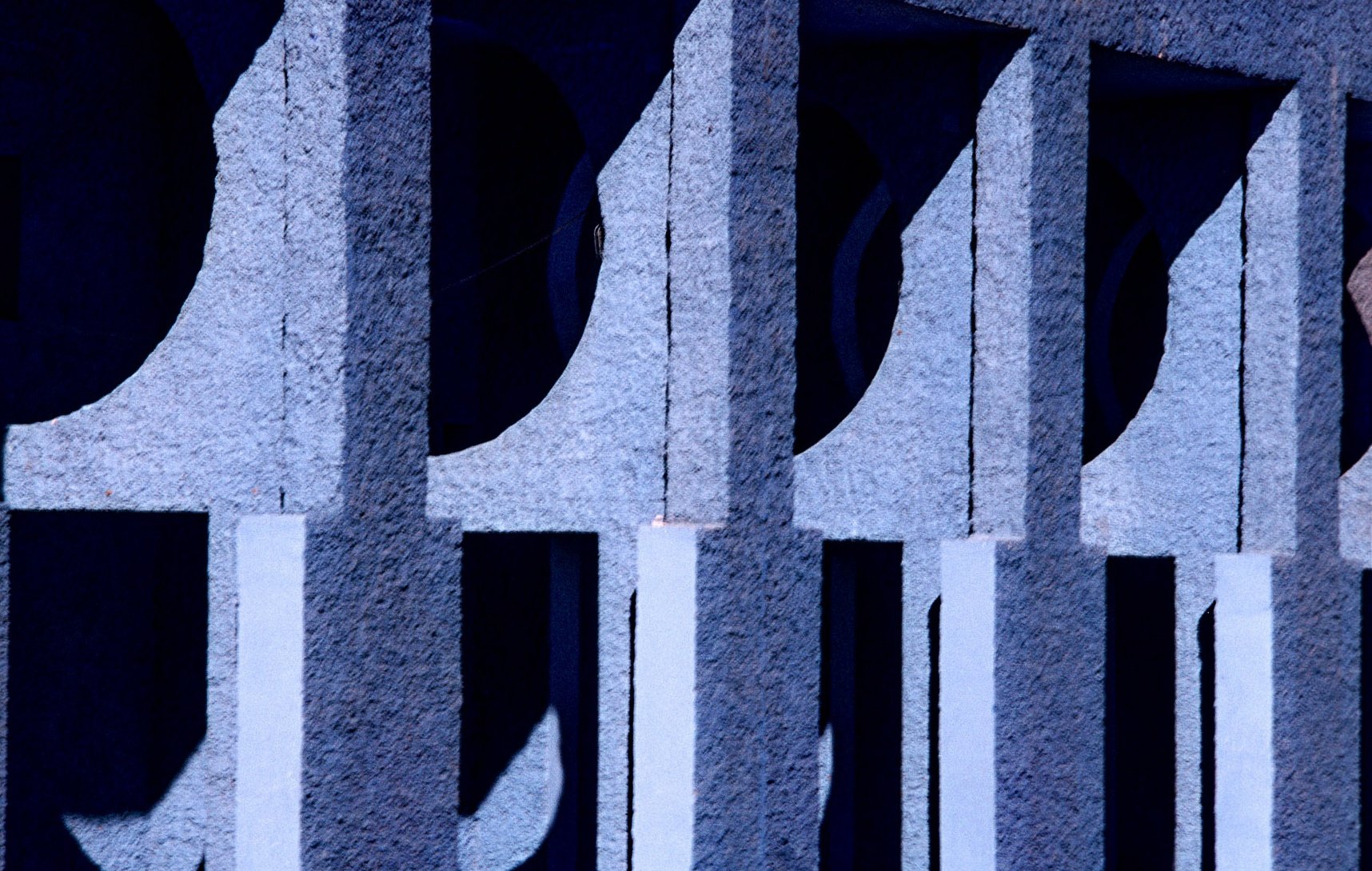
Detail from Houari Boumedienne Agricultural Village, socialist commune in Abadla, Algeria –– Ricardo Bofill (Architect)
//
The natural subject was at hand
Sick as a
ingredient
Anywhere there is economy
It is hard to live
Chopping (trees)
In the miscellaneous category
Affinity jags
tread, trade
Carnal berry/wall blue
North girth
Exurb
Neither-enjoyer
Nor-sport
Posting
Fleuve of Mal
Not writing
The hen eats maggots on the path to the sky where all the stars are nails
the peacock just lies
[EDITOR'S NOTE: In an attempt to think collectively about new ways to engage poetics, translation,
+ revolutionary history, I asked Max to offer a note on the poetic process he described (passingly)
as "fried translation." He was kind enough to indulge me. Results below. ––J.A.B.]
1. Translation as grain delay: an audio effect that truncates sound into minute "grains" and then
rearranges them, glitching, repitching, texturizing, etc. (Sometimes you get that sublime musique concrète
thing where the post- resembles 0% of the pre-.) The idea is to do this with language. Glom onto a few grains
(etymological "false friends," phonemes, diacritics, even graphemes that suggest alternatives to themselves,
like the "h" hiding in "b") from a source text in "French," for example. Then translate those bits into something
that appears to be "English" but jams our expectations of "English." As far as I'm concerned, the degree to which the
"fluency" of a text in translation is achieved is the degree to which it speaks empire fluently. I'd rather translate
in a way that resists that gold-standard of fluency, that leaves text somewhere between what we've come to think of as
"original" and "derivative," somewhere in intermittency. A poem that draws attention to the fact that it's "in translation,"
really, right now.
2. Take a frequency––say 440 Hz on a piano––and translate imperceptibly small bits of attack, decay,
and release into infinite, uncanny sustain. Do the same with a source text's attachments to historical
attacks, decays, releases. Make them sustain.
3. Neural machine translation services want all potential language to become utterly predictable.
Poetry wants the opposite. Low resolution, motion blur, bad handwriting as antivenom.
Max Gontarek wrote Study for Swimming Hole (Community Mausoleum, 2025) and Goat Foil (TABLOID, 2026). He lives in Versailles.