MERIDEL LE SUEUR:
Annunciation (1935)
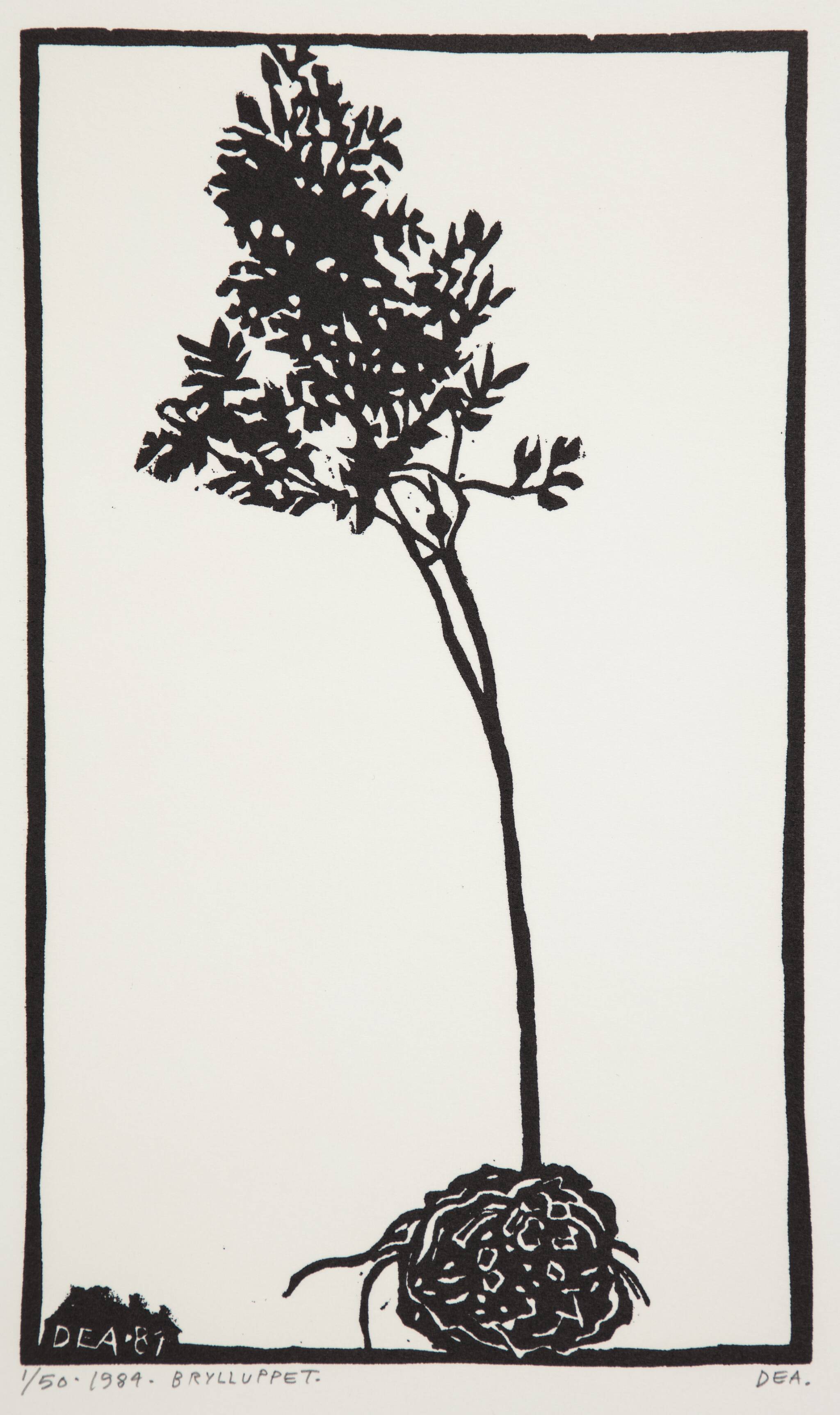
Dea Trier Mørch, “Brylluppet” (1984)
Meridel Le Sueur was a communist, raised by a family heavily involved in the many midwestern efforts to win democratic control of the nation: stumping for Debs, teaching at the People's College, struggling to form the Nonpartisan League (and, in her step-father Arthur Le Sueur's case, briefly serving as socialist mayor of Minot, North Dakota). Meridel eventually settled in Depression-era Minneapolis, where she found the source of her mature artistic and political consciousness in the General Strike of 1934, on display in "I Was Marching:
Our life seems to be marked with a curious and muffled violence over America, but this action has always been in the dark, men and women dying obscurely, poor and poverty marked lives, but now from city to city runs this violence, into the open, and colossal happenings stand bare before our eyes, the street churning suddenly upon the pivot of mad violence, whole men suddenly spouting blood and running like living sieves, another holding a dangling arm shot squarely off, a tall youngster, running, tripping over his intestines, and one block away, in the burning sun, gay women shopping and a window dresser trying to decide whether to put green or red voile on a mannikin.
In these terrible happenings you cannot be neutral now. No one can be neutral in the face of bullets.
Le Sueur subsequently committed herself to militancy, literary and otherwise, and during the McCarthy era was blacklisted by the FBI, spending decades evading its repression and eking a life at the margins. In the '70s, second-wave feminists revived her writing, including the story below.
At her peak, Le Sueur defines the world in gravid plainness––a direct apprehension, a refusal to release contradiction––and it is via this aesthetic method that she splits the simplistic conception of proletarian identity, shattering its unchallenged masculine basis and revealing the pith underneath: that class is never a transparent category; it is always further mediated; it is visible not only on the shopfloor but in women's desperation with children, at the aid office with middleclass women denying them iron, in the butchery of backdoor abortions or mandated sterilization and in the ceaseless threat of men, the consequent perversion of women's own love, the many deaths and half-lives of women's socially inscribed insanity.
Meridel's example is of total devotion to the world: to live in its real motion, and to say what is. To show us its face in the billions that form it. We are very lucky to show you some of her best work, here, with "Annunciation."
—J.A.B.
It reminds me of if Dewey Dell, one of my heroes, had written a story.
—C.R.
For Rachel
Ever since I have known I was going to have a child I have kept writing things down on these little scraps of paper. There is something l want to say, something I want to make clear for myself and others. One lives all one's life in a sort of way, one is alive and that is about all that there is to say about it. Then something happens.
There is the pear tree I can see in the afternoons as I sit on this porch writing these notes. It stands for something. It has had something to do with what has happened to me. I sit here all afternoon in the autumn sun and then I begin to write something on this yellow paper; something seems to be going on like a buzzing, a flying and circling within me, and then I want to write it down in some way. I have never felt this way before, except when I was a girl and was first in love and wanted then to set things down on paper so that they would not be lost. It is something perhaps like a farmer who hears the swarming of a host of bees and goes out to catch them so that he will have honey. If he does not go out right away, they will go, and he will hear the buzzing growing more distant in the afternoon.
My sweater pocket is full of scraps of paper on which I have written. I sit here many afternoons while Karl is out looking for work, writing on pieces of paper, unfolding, reading what I have already written.
We have been here two weeks at Mrs. Mason's boarding house. The leaves are falling and there is a golden haze over everything. This is the fourth month for me and it is fall. A rich powerful haze comes down from the mountains over the city. In the afternoon I go out for a walk. There is a park just two blocks from here. Old men and tramps lie on the grass all day. It is hard to get work. Many people besides Karl are out of work. People are hungry just as I am hungry. People are ready to flower and they cannot. In the evenings we go there with a sack of old fruit we can get at the stand across the way quite cheap, bunches of grapes and old pears. At noon there is a hush in the air and at evening there are stirrings of wind coming from the sky, blowing in the fallen leaves, or perhaps there is a light rain, falling quickly on the walk. Early in the mornings the sun comes up hot in the sky and shines all day through the mist. It is strange, I notice all these things, the sun, the rain falling, the blowing of the wind. It is as if they had a meaning for me as the pear tree has come to have.
In front of Mrs. Mason's house there is a large magnolia tree with its blossoms yellow, hanging over the steps almost within reach. Its giant leaves are motionless and shining in the heat, occasionally as I am going down the steps toward the park one falls heavily on the walk.
This house is an old wooden one, that once was quite a mansion I imagine. There are glass chandeliers in the hall and fancy tile in the bathrooms. It was owned by the rich once and now the dispossessed live in it with the rats. We have a room three flights up. You go into the dark hallway and up the stairs. Broken settees and couches sit in the halls. About one o'clock the girls come down stairs to get their mail and sit on the front porch. The blinds go up in the old wooden house across the street. It is always quite hot at noon.
Next to our room lies a sick woman in what is really a kind of closet with no windows. As you pass you see her face on the pillow and a nauseating odor of sickness comes out the door. I haven't asked her what is the matter with her but everyone knows she is waiting for death. Somehow it is not easy to speak to her. No one comes to see her. She has been a housemaid all her life tending other people's children; now no one comes to see her. She gets up sometimes and drinks a little from the bottle of milk that is always sitting by her bed covered with flies.
Mrs. Mason, the landlady, is letting us stay although we have only paid a week's rent and have been here over a week without paying. But it is a bad season and we may be able to pay later. It is better perhaps for her than having an empty room. But I hate to go out and have to pass her door and I am always fearful of meeting her on the stairs. I go down as quietly as I can but it isn't easy, for the stairs creak frightfully.
The room we have on the top floor is a back room, opening out onto an old porch which seems to be actually tied to the wall of the house with bits of wire and rope. The floor of it slants downward to a rickety railing. There is a box perched on the railing that has geraniums in it. They are large, tough California geraniums. I guess nothing can kill them. I water them since I have been here and a terribly red flower has come. It is on this porch I am sitting. Just over the banisters stand the top branches of a pear tree.
Many afternoons I sit here. It has become a kind of alive place to me. The room is dark behind me, with only the huge walnut tree scraping against the one window over the kitchenette. If I go to the railing and look down I can see far below the back yard which has been made into a garden with two fruit trees and I can see where a path has gone in the summer between a small bed of flowers, now only dead stalks. The ground is bare under the walnut tree where little sun penetrates. There is a dog kennel by the round trunk but there doesn't ever seem to be a dog. An old wicker chair sits outdoors in rain or shine. A woman in an old wrapper comes out and sits there almost every afternoon. I don’t know who she is, for I don't know anybody in this house, having to sneak downstairs as I do.
Karl says I am foolish to be afraid of the landlady. He comes home drunk and makes a lot of noise. He says she's lucky in these times to have anybody in her house, but I notice in the mornings he goes down the stairs quietly and often goes out the back way.
I'm alone all day so I sit on this rickety porch. Straight out from the rail so that I can almost touch it is the radiating frail top of the pear tree that has opened a door for me. If the pears were still hanging on it each would be alone and separate with a kind of bloom upon it. Such a bloom is upon me at this moment. Is it possible that everyone, Mrs. Mason who runs this boarding house, the woman next door, the girls downstairs, all in this dead wooden house have hung at one time, each separate in a mist and bloom upon some invisible tree? I wonder if it is so.
I am in luck to have this high porch to sit on and this tree swaying before me through the long afternoons and the long nights. Before we came here, after the show broke up in S.F. we were in an old hotel, a foul-smelling place with a dirty chambermaid and an old cat in the halls, and night and day we could hear the radio going in the office. We had a room with a window looking across a narrow way into another room where a lean man stood in the mornings looking across, shaving his evil face. By leaning out and looking up I could see straight up the sides of the tall building and above the smoky sky.
Most of the time I was sick from the bad food we ate. Karl and I walked the streets looking for work. Sometimes I was too sick to go. Karl would come in and there would be no money at all. He would go out again to perhaps borrow something. I know many times he begged although we never spoke of it, but I could tell by the way he looked when he came back with a begged quarter. He went in with a man selling Mexican beans but he didn't make much. I lay on the bed bad days feeling sick and hungry, sick too with the stale odor of the foul walls. I would lie there a long time listening to the clang of the city outside. I would feel thick with this child. For some reason I remember that I would sing to myself and often became happy as if mesmerized there in the foul room. It must have been because of this child. Karl would come back perhaps with a little money and we would go out to a dairy lunch and there have food I could not relish. The first alleyway I must give it up with the people all looking at me.
Karl would be angry. He would walk on down the street so people wouldn't think he was with me. Once we walked until evening down by the docks. “Why don't you take something?” he kept saying. “Then you wouldn't throw up your food like that. Get rid of it. That's what everybody does nowadays. This isn't the time to have a child. Everything is rotten. We must change it.” He kept on saying, “Get rid of it. Take something why don't you?” And he got angry when I didn't say anything but just walked along beside him. He shouted so loud at me that some stevedores loading a boat for L.A. laughed at us and began kidding us, thinking perhaps we were lovers having a quarrel.
Some time later, I don’t know how long it was, for I hadn’t any time except the nine months I was counting off, but one evening Karl sold enough Mexican jumping beans at a carnival to pay our fare, so we got on a river boat and went up the river to a delta town. There might be a better chance of a job. On this boat you can sit up all night if you have no money to buy a berth. We walked all evening along the deck and then when it got cold we went into the saloon because we had pawned our coats. Already at that time I had got the habit of carrying slips of paper around with me and writing on them, as I am doing now. I had a feeling then that something was happening to me of some kind of loveliness I would want to preserve in some way. Perhaps that was it. At any rate I was writing things down. Perhaps it had something to do with Karl wanting me all the time to take something. “Everybody does it,” he kept telling me. “It's nothing, then it's all over.” I stopped talking to him much. Everything I said only made him angry. So writing was a kind of conversation I carried on with myself and with the child.
Well, on the river boat that night after we had gone into the saloon to get out of the cold, Karl went to sleep right away in a chair. But I couldn't sleep. I sat watching him. The only sound was the churning of the paddle wheel and the lap of the water. I had on then this sweater and the notes I wrote are still in the breast pocket. I would look up from writing and see Karl sleeping like a young boy.
“Tonight, the world into which you are coming”—then I was speaking to the invisible child—“is very strange and beautiful. That is, the natural world is beautiful. I don't know what you will think of man, but the dark glisten of vegetation and the blowing of the fertile land wind and the delicate strong step of the sea wind, these things are familiar to me and will be familiar to you. I hope you will be like these things. I hope you will glisten with the glisten of ancient life, the same beauty that is in a leaf or a wild rabbit, wild sweet beauty of limb and eye. I am going on a boat between dark shores, and the river and the sky are so quiet that I can hear the scurryings of tiny animals on the shores and their little breathings seem to be all around. I think of them, wild, carrying their young now, crouched in the dark underbrush with the fruit-scented land wind in their delicate nostrils, and they are looking out at the moon and the fast clouds. Silent, alive, they sit in the dark shadow of the greedy world. There is something wild about us too, something tender and wild about my having you as a child, about your crouching so secretly here. There is something very tender and wild about it. We, too, are at the mercy of many hunters. On this boat I act like the other human beings, for I do not show that I have you, but really I know we are as helpless, as wild, as at bay as some tender wild animals who might be on the ship.
“I put my hand where you lie so silently. I hope you will come glistening with life power, with it shining upon you as upon the feathers of birds. I hope you will be a warrior and fierce for change, so all can live.”
Karl woke at dawn and was angry with me for sitting there looking at him. Just to look at me makes him angry now. He took me out and made me walk along the deck although it was hardly light yet. I gave him the “willies” he said, looking at him like that. We walked round and round the decks and he kept talking to me in a low voice, trying to persuade me. It was hard for me to listen. My teeth were chattering with cold, but anyway I found it hard to listen to anyone talking, especially Karl. I remember I kept thinking to myself that a child should be made by machinery now, then there would be no fuss. I kept thinking of all the places I had been with this new child, traveling with the show from Tia Juana to S.F. In trains, over mountains, through deserts, in hotels and rooming houses, and myself in a trance of wonder. There wasn't a person I could have told it to, that I was going to have a child. I didn't want to be pitied. Night after night we played in the tent and the faces were all dust to me, but traveling, through the window the many vistas of the earth meant something—the bony skeleton of the mountains, like the skeleton of the world jutting through its flowery flesh. My child too would be made of bone. There were the fields of summer, the orchards fruiting, the berry fields and the pickers stooping, the oranges and the grapes. Then the city again in September and the many streets I walk looking for work, stopping secretly in doorways to feel beneath my coat.
It is better in this small town with the windy fall days and the sudden rain falling out of a sunny sky. I can't look for work any more. Karl gets a little work washing dishes at a wienie place. I sit here on the porch as if in a deep sleep waiting for this unknown child. I keep hearing this far flight of strange birds going on in the mysterious air about me. This time has come without warning. How can it be explained? Everything is dead and closed, the world a stone, and then suddenly everything comes alive as it has for me, like an anemone on a rock, opening itself, disclosing itself, and the very stones themselves break open like bread. It has all got something to do with the pear tree too. It has come about some way as I have sat here with this child so many afternoons, with the pear tree murmuring in the air.
The pears are all gone from the tree but I imagine them hanging there, ripe curves within the many scimitar leaves, and within them many pears of the coming season. I feel like a pear. I hang secret within the curling leaves, just as the pear would be hanging on its tree. It seems possible to me that perhaps all people at some time feel this, round and full. You can tell by looking at most people that the world remains a stone to them and a closed door. I'm afraid it will become like that to me again. Perhaps after this child is born, then everything will harden and become small and mean again as it was before. Perhaps I would even have a hard time remembering this time at all and it wouldn't seem wonderful. That is why I would like to write it down.
How can it be explained? Suddenly many movements are going on within me, many things are happening, there is an almost unbearable sense of sprouting, of bursting encasements, of moving kernels, expanding flesh. Perhaps it is such an activity that makes a field come alive with millions of sprouting shoots of corn or wheat. Perhaps it is something like that that makes a new world.
I have been sitting here and it seems as if the wooden houses around me had become husks that suddenly as I watched began to swarm with livening seed. The house across becomes a fermenting seed alive with its own movements. Everything seems to be moving along a curve of creation. The alley below and all the houses are to me like an orchard abloom, shaking and trembling, moving outward with shouting. The people coming and going seem to hang on the tree of life, each blossoming from himself. I am standing here looking at the blind windows of the house next door and suddenly the walls fall away, the doors open, and within I see a young girl making a bed from which she had just risen having dreamed of a young man who became her lover… she stands before her looking-glass in love with herself.
I see in another room a young man sleeping, his bare arm thrown over his head. I see a woman lying on a bed after her husband has left her. There is a child looking at me. An old woman sits rocking. A boy leans over a table reading a book. A woman who has been nursing a child comes out and hangs clothes on the line, her dress in front wet with milk. A young woman comes to an open door looking up and down the street waiting for her young husband. I get up early to see this young woman come to the door in a pink wrapper and wave to her husband. They have only been married a short time, she stands waving until he is out of sight and even then she stands smiling to herself, her hand upraised.
Why should I be excited? Why should I feel this excitement, seeing a woman waving to her young husband, or a woman who has been nursing a child, or a young man sleeping? Yet I am excited. The many houses have become like an orchard blooming soundlessly. The many people have become like fruits to me, the young girl in the room alone before her mirror, the young man sleeping, the mother, all are shaking with their inward blossoming, shaken by the windy blooming, moving along a future curve.
I do not want it all to go away from me. Now many doors are opening and shutting, light is falling upon darkness, closed places are opening, still things are now moving. But there will come a time when the doors will close again, the shouting will be gone, the sprouting and the movement and the wondrous opening out of everything will be gone. I will be only myself. I will come to look like the women in this house. I try to write it down on little slips of paper, trying to preserve this time for myself so that afterwards when everything is the same again I can remember what all must have.
This is the spring there should be in the world, so I say to myself, "Lie in the sun with the child in your flesh shining like a jewel. Dream and sing, pagan, wise in your vitals. Stand still like a fat budding tree, like a stalk of corn athrob and aglisten in the heat. Lie like a mare panting with the dancing feet of colts against her sides. Sleep at night as the spring earth. Walk heavily as a wheat stalk at its full time bending toward the earth waiting for the reaper. Let your life swell downward so you become like a vase, a vessel. Let the unknown child knock and knock against you and rise like a dolphin within.”
I look at myself in the mirror. My legs and head hardly make a difference, just a stem my legs. My hips are full and tight in back as if bracing themselves. I look like a pale and shining pomegranate, hard and tight, and my skin shines like crystal with the veins showing beneath blue and distended. Children are playing outside and girls are walking with young men along the walk. All that seems over for me. I am a pomegranate hanging from an invisible tree with the juice and movement of seed within my hard skin. I dress slowly. I hate the smell of clothes. I want to leave them off and just hang in the sun ripening… ripening.
It is hard to write it down so that it will mean anything. I've never heard anything about how a women feels who is going to have a child, or about how a pear tree feels bearing its fruit. I would like to read these things many years from now, when I am barren and no longer trembling like this, when I get like the women in this house, or like the woman in the closed room, I can hear her breathing through the afternoon.
When Karl has no money he does not come back at night. I go out on the street walking to forget how hungry I am. This is an old town and along the streets are many old strong trees. Night leaves hang from them ready to fall, dark and swollen with their coming death. Trees, dark, separate, heavy with their down-hanging leaves, cool surfaces hanging on the dark. I put my hand among the leaf sheaves. They strike with a cool surface, their glossy surfaces surprising me in the dark. I feel like a tree swirling upwards too, muscular sap alive, with rich surfaces hanging from me, flaring outward rocket-like and falling to my roots, a rich strong power in me to break through into a new life. And dark in me as l walk the streets of this decayed town are the buds of my child. I walk alone under the dark flaring trees. There are many houses with the lights shining out but you and I walk on the skirts of the lawns amidst the down-pouring darkness. Houses are not for us. For us many kinds of hunger, for us a deep rebellion.
Trees come from a far seed walking the wind, my child too from a far seed blowing from last year's rich and revolutionary dead. My child budding secretly from far-walking seed, budding secretly and dangerously in the night.
The woman has come out and sits in the rocker, reading, her fat legs crossed. She scratches herself, cleans her nails, picks her teeth. Across the alley lying flat on the ground is a garage. People are driving in and out. But up here it is very quiet and the movement of the pear tree is the only movement and I seem to hear its delicate sound of living as it moves upon itself silently, and outward and upward.
The leaves twirl and twirl all over the tree, the delicately curving tinkling leaves. They twirl and twirl on the tree and the tree moves far inward upon its stem, moves in an invisible wind, gently swaying. Far below straight down the vertical stem like a stream, black and strong into the ground, runs the trunk; and invisible, spiraling downward and outward in powerful radiation, lie the roots. I can see it spiraling upward from below, its stem straight, and from it, spiraling the branches season by season, and from the spiraling branches moving out in quick motion, the forked stems, and from the stems twirling fragilely the tinier stems holding outward until they fall, the half-curled pear leaves.
Far below lies the yard, lying flat and black beneath the body of the upshooting tree, for the pear tree from above looks as if it had been shot instantaneously from the ground, shot upward like a rocket to break in showers of leaves and fruits twirling and falling. Its movement looks quick, sudden and rocketing. My child when grown can be looked at in this way as if it suddenly existed… but I know the slow time of making. The pear tree knows.
Far inside the vertical stem there must be a movement, a river of sap rising from below and radiating outward in many directions clear to the tips of the leaves. The leaves are the lips of the tree speaking in the wind or they move like many tongues. The fruit of the tree you can see has been a round speech, speaking in full tongue on the tree, hanging in ripe body, the fat curves hung within the small curves of the leaves. I imagine them there. The tree has shot up like a rocket, then stops in midair and its leaves flow out gently and its fruit curves roundly and gently in a long slow curve. All is gentle on the pear tree after its strong upward shooting movement.
I sit here all the afternoon as if in its branches, amidst the gentle and curving body of the tree. I have looked at it until it has become more familiar to me than Karl. It seems a strange thing that a tree might come to mean more to one than one's husband. It seems a shameful thing even. I am ashamed to think of it but it is so. I have sat here in the pale sun and the tree has spoken to me with its many tongued leaves, speaking through the afternoon of how to round a fruit. And I listen through the slow hours. I listen to the whispering of the pear tree, speaking to me, speaking to me. How can I describe what is said by a pear tree? Karl did not speak to me so. No one spoke to me in any good speech.
There is a woman coming up the stairs, slowly. I can hear her breathing. I can hear her behind me at the screen door.
She came out and spoke to me. I know why she was looking at me so closely. “I hear you're going to have a child,” she said. “It's too bad.” She is the same color as the dead leaves in the park. Was she once alive too?
I am writing on a piece of wrapping paper now. It is about ten o'clock. Karl didn't come home and I had no supper. I walked through the streets with their heavy, heavy trees bending over the walks and the lights shining from the houses and over the river the mist rising.
Before I came into this room I went out and saw the pear tree standing motionless, its leaves curled in the dark, its radiating body falling darkly, like a stream far below into the earth.