A FESTIVAL OF CREATIVITY AND RESISTANCE
Zaineb Majoka
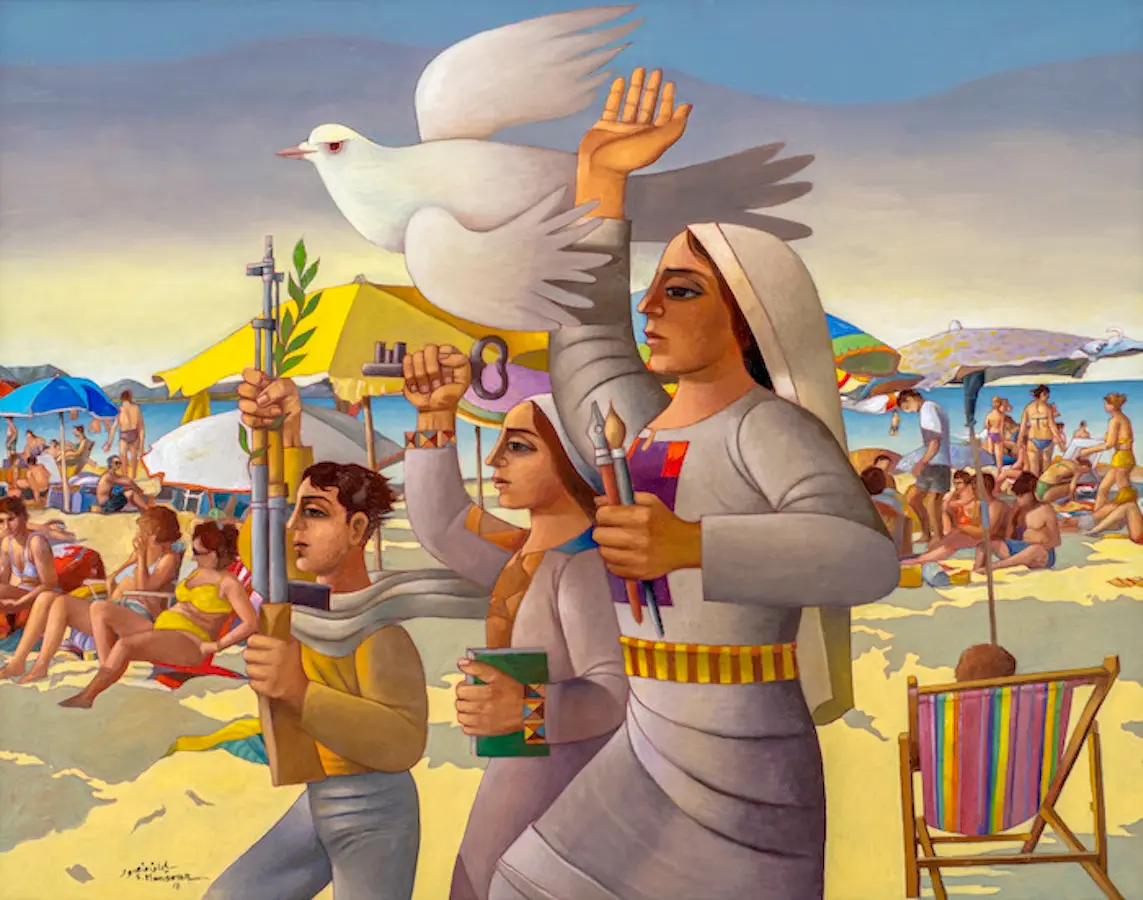
The Sea is Mine (2016) –– Sliman Mansour
Working-class literature emerged as a response to the social and economic changes brought about by the Industrial Revolution. Authors, whether of working-class background or not, began to focus on the hardships faced by the working class, documenting and highlighting the harsh realities of industrial life. Their work often intersected with other movements including fights against racism, colonialism, and sexism.
Two illustrative works are Sons and Lovers by D.H. Lawrence and God’s Bits of Wood by Sembène Ousmane. The first one is a semi-autobiographical novel set in a mining village in England, in which Lawrence traces how mining work left its mark on every aspect of life. The protagonist's father, a collier, is defined by constant setbacks that take a toll on his mental and physical health. His wages never cover basic needs, so the mother's life revolves around making ends meet and around her fierce push to move their sons from pit work to clerical jobs. The second novel is a fictionalized account of the 1940s railroad strike on the Dakar-Niger line in French West Africa that emphasizes the role women and common people played in rising against the colonial oppressors to demand their rights as workers.
Initially inspired by Marxist writings, the movement was referred to as proletariat literature. But as countries began to deindustrialize, leading to a rise of the services sector and a decline in traditional manufacturing industries, labor literature also evolved and began to encompass the whole working class.
To celebrate the linkage between art, politics, and movement building, Bol Co-op, a worker owned bookstore, organized Washington DC’s first annual Working-Class Literature Festival on May 1st and 2nd, 2026.
Writers, activists, and political leaders have often used fiction to expose the exploitation and mistreatment of workers, which helped to raise public awareness, build solidarities, and galvanize support for the labor movement. Michael Gold’s Jews Without Money is a pertinent example, depicting tenement life in a Jewish neighborhood in New York City where poverty was the defining feature. Published in 1930 at the onset of the Great Depression, it was reprinted over the following years, and by the 1940s was being issued by International Publishers, the house long associated with the Communist Party USA. International had by then built its own distribution channel — a book-buying club on a dollar-a-year subscription — ensuring that left-wing titles reached the worker-readers.
The inspiration for the 2026 Working-Class Literature Festival came from Florence, Italy’s annual Festival di Letteratura Working Class, which began in 2022. The Italian festival emerged in response to the 2021 struggle at British multinational auto and aerospace parts company GKN after workers were fired via a WhatsApp message. Instead of accepting their dismissal, the workers decided to occupy the factory. They soon got support from the community and other workers throughout Europe, ensuring that the factory remained occupied. In 2022, the writer/translator Alberto Prunetti, in collaboration with the GKN Factory Collective, organized the festival in the very factory.
Inspired by the approach taken in Florence, the Working-Class Literature Festival in DC relied primarily on crowdfunding, support from the unions and other organizations that work on building economic solidarity, and volunteer labor. Rather than targeting an audience well-versed in the vocabulary and nuances of literature’s history by bringing in acclaimed writers and publishers, the festival featured writers who may or may not be published or have formal training, but whose work highlights the issues of the working class.
The festival also emphasized the roses in Bread and Roses, via two beliefs:
- Culture (and leisure) should be accessible to all. Literature festivals are often targeted at a certain demographic (the affluent and formally educated), but this festival chose sessions and speakers that came from different walks of life. For this, the festival worked closely with unions, mutual aids, and other community organizations.
- Working-class literature often highlights hardship and labor, but these themes are not the sole defining features of working people’s lives. The festival tried to bring in works that convey the fullness of existence, including joy and laughter.
The opening event on Friday, May 1st set the tone with “More Than a Living,” a moderated poetry session featuring local poets Sunu Chandy, Tahira Raza, and Brian Gilmore, whose work centered the experiences of working life under capitalism. During the session, the poets read their work, talked about their inspiration and writing process, and tried to take the audience beyond the page and into the lives of working people. Gilmore read one of his poems that narrated a driver connecting with a highway toll collector through fleeting interactions. The driver finds himself concerned about her well-being in the face of impending automation of her job. In the poem, this small act of recognition affirms her humanity; the poem also reflected Black solidarity.
The following day deepened this through two fiction panels. “No Struggle Stands Alone” examined how labor exists within the broader systems of race, empire, patriarchy, and global capital. Ra Singh, through her novel Earthly Playing Field, implores the reader to recognize how comforts offered by life in the imperial core are at the expense of people around the world, from Palestinians in Gaza to farmers in India. Seraj Assi, whose upcoming novel Red Flour is a love story set in Gaza amid the ongoing genocide, emphasized the challenge of writing fiction in such circumstances. EA Mayes wrapped up the discussion by unpacking how the ruling class considers fiction a potential propaganda tool to glorify police and military power, and that engaged writers can subvert the normalization of these systems of power. Her work engages with this dynamic through noir-style detective novels, which expose the dark workings of the state. These speakers underscored that no struggle exists in a vacuum.
In the panel “From Page to Picket Line,” speakers traced the long arc of working-class resistance in fiction, from 19th century miners to contemporary warehouse workers, asking what literature can teach us about organizing and collective power. Writers discussed recent works, including short stories of human encounters in the Gaza genocide, a fictionalized account of early 20th century mining life in Colorado, and challenges of organizing among the immigrant workers. One thing that stood out is that the works of fiction often require a lot of research to tell a convincing story—Molly Sturdevant, for instance, showed clippings from her archival research for her novel The Sleepers, which depicts bosses using spies and underhand tactics to undermine a miners union.
Beyond the panels and performances, the festival created a public square where attendees could interact with each other and with other labor organizers. A few local organizations working on labor and intersecting issues set up tables, turning the space into a practical resource as much as a cultural event. It was complemented with a curated book collection by Bol Co-op that focused on labor history, workers' movements, and working-class fiction. With around 500 people moving through over the two days, many coming directly from May Day rallies, the festival drew together readers, organizers, and writers in a way that felt less like a literary event and more like an extension of the movement itself.
Zaineb Majoka lives and works in Washington, DC, where she helped found Bol Worker-Owned Co-op Bookstore. She enjoys historical fiction, good coffee, and organizing for human rights in Pakistan. She was the lead organizer of the Working Class Literature Festival 2026.