LEVí MARRERO
The Survivor
tr. Langston Hughes
From its opening lines—"He is not dead yet. Perhaps he will not die for a long time”—Leví Marrero’s short story, “The Survivor,” translated here by the poet Langston Hughes, distances itself from more triumphant works of socialist realism. Instead, the reader finds a subdued narrator in Juan Francisco Davila and can’t help but wonder if his “yet” is written out of a sense of comfort, however cold, or if it instead speaks of a bleak aspiration. In other words, does the revolutionary face forward or back?
“Survivor!” Davila continues. “The men who are called by that name in Cuba always seem to be other than they were before.” So, the past doesn’t tug at his waist and a cloudless future does not beckon him; he is ruptured from the force that delivered him to the streets and which carries others onward. He is on an island of time and social position. Romain Rolland’s dictate: “Il faut allier le pessimisme de l’intelligence à l’optimisme de la volonté” no longer applies—Davila’s stores have been used.
He tells us that before being brought to a cell, soldiers marched him along a cliff where other prisoners had been thrown to their deaths. In that half a minute, the prisoner could claim his end. He could let himself slip. His comrades would believe the soldiers did it; he would be a martyr. By the time the reader finds him, though, that moment has passed.
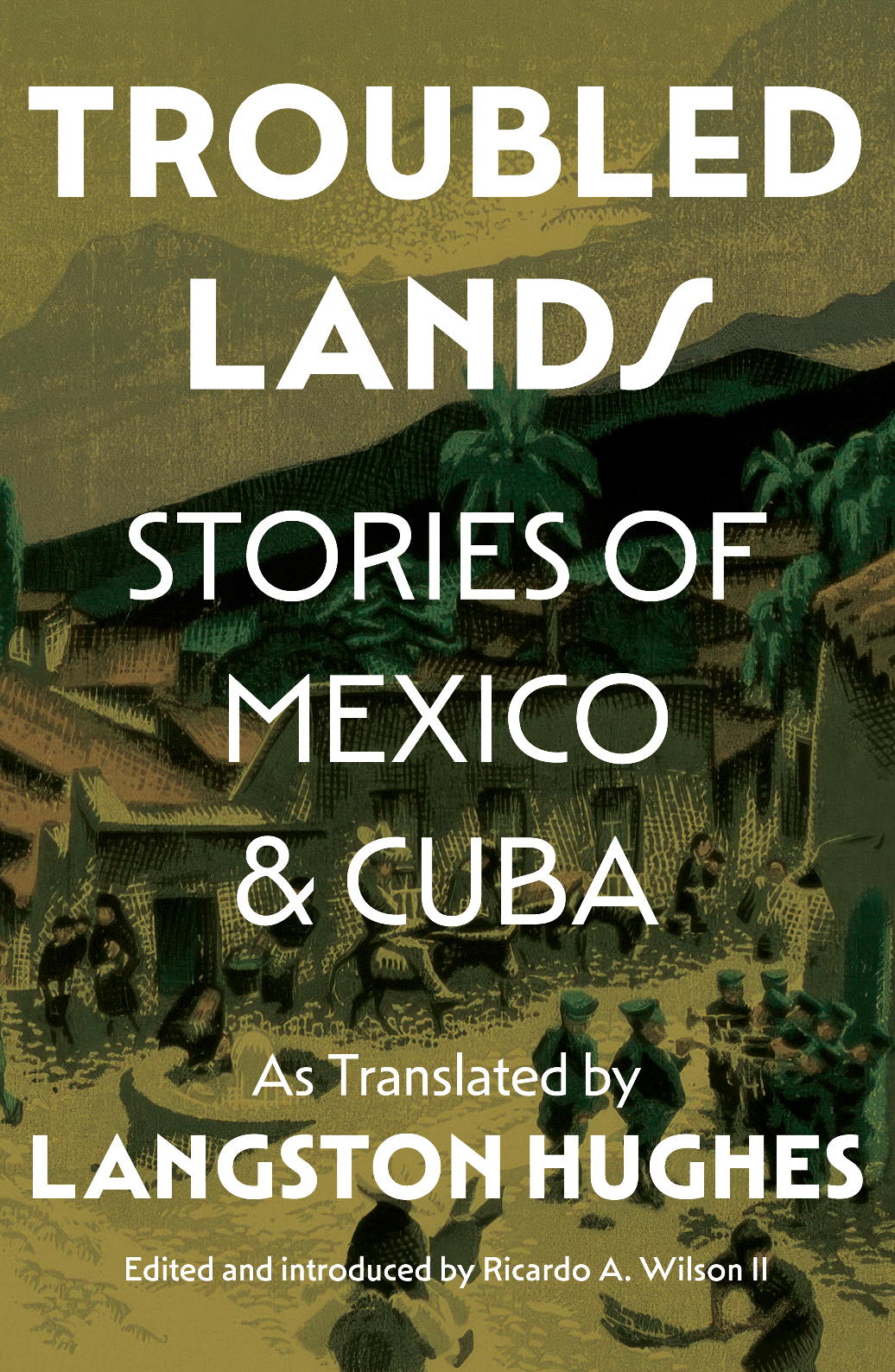
And yet, the revolution he took part in succeeded. His ambivalence, and Marrero’s opening where others might end, stood out to me among the works of Cuban and Mexican writers translated by Hughes in the 1930s, which have now been edited by Ricardo A. Wilson II and published by Princeton University Press under the title Troubled Lands: Stories of Mexico & Cuba. It’s a collection well worth reading in full, but we’re privileged to publish this selection for you.
—A.D.He is not dead yet. Perhaps he will not die for a long time. Like all those who succeed in living through impossible moments, escaping when all seems hopelessly lost, he is now a man overlooked by destiny—a survivor of fate.
Survivor! The men who are called by that name in Cuba always seem to be other than they were before. For him, this description—a bit literary—is harshly real. A simple boy who was once nineteen years old is now a man come back from every turbid complexity of life. A man to whom nothing matters. It took but two years to bring about this change.
Or rather: two hours.
When he talks, nobody could guess his tragedy, could tell that now nothing means anything to him. In the late afternoon, the sunset melts to gold. In his room, secluded and silent, to which of late only a few friends come, his past life still lives. Photographs of picnics, of ball fields. Books in cases, on the tables, on the shelves, all around. . . . That was a time when he could enjoy life, laugh, dance, sing, feel. But now nobody could tear from him the confession of his terrible sufferings.
In the distance, from his window that is too high—ten stories high—you could see the lovely city of Havana taking advantage of its last minute of sun. Street cars crawling by full of office workers; girls like spots of color flowing along the sidewalks; autos full of people. From above, all this seemed flat and tiny and unimportant today.
He looked at life from his lonely corner, among the few objects that now made up his intimacy. Outside were all those other living things that no longer mattered—but that once had hurled him into that terrific fight for happiness for all, that search now ended.
Happiness for all! Formerly the phrase had held for him the dynamics of a magic slogan. It did not matter that those important men who could have profitably secured the building of a just order had left him and his companions alone by themselves—young students, in union with a few others, fighting heroically their permanent and obscure battle against organized power.
Bombs and gunplay every day. The same bombs and guns that now the gangsters and the unfit kept on using.
Ten months ago the revolution had ushered in the new order. New? The word seemed presumptuous. But at least more than three thousand men, who made up the former murder-oligarchy, had fled the country in mad flight from the wrath of the Cuban people.
Then the return of those who had formerly been compelled to run away in the days of the tyrant. New names in public places. Revolutionary groups coming out into the light of day, their numbers swollen by victory. Within a month, the springing up of a hundred million “revolutionaries”—without there ever having been a revolution!
He felt beaten, conquered.
Did the other boys feel like him? Perhaps not. His case was different. Different!
Three hours ago, the revelation had come that probably everybody knew his secret. He was with his sweetheart, Marisabel. They were alone, in the same parlor that had seen the birth of their love, talking listlessly, recalling the years when they skated gaily over the surface of life. And suddenly, confirming his fears, a kind of unexpected confusion overcame him, burning his throat.
She said, “I can’t believe it! But you are not the same.”
And, although he was not entirely right, he felt that his secret had surely been disclosed, and that she, too, had discovered his tragedy.
Down in the street, people were walking slowly, with no aim.
He remembered how he went into the struggle against Machado, the dictator—wholeheartedly, from the very beginning. Warm young blood flowed. The revolutionary situation sharpened. His student life was left completely behind him, hour by hour, the daily fight became more tense, more tragic.
Imprisonment, death, torture!
One day it fell his lot to be taken prisoner.
That night a military car carried him to an Old Spanish fortress that had been turned into a jail. Orders. Questions. Then a voice like a whip lashed everyone into attention.
“Juan Francisco Davila!” His name.
Cries of protest from his companions, “They’re going to kill him!”
“You can’t take him away from us!”
“Assassins!”
A few moments of desperate resistance.
Some of his comrades fell beneath their blows. And the car continued its trip.
Havana seemed to sleep in precarious peace. In the distance, you could hear the usual bomb exploding, as the car passed through the dark, lonely, unworthy streets.
He knew that he might die at any moment, but that didn’t matter. He had come to the point where he had forgotten life—or had learned to despise it.
At last they came to another fort. Silence.
In the distance he heard a voice, “Sentinel! A new prisoner.” They pushed him toward that slope that has seen any number of young men hurled defenseless into the sea.
“Be careful!” Words of mockery and menace from every sentry post on the little road winding upward to the fort. Armed shadows gliding over the incline, silent, impenetrable.
Twenty, thirty seconds of transit and, at the end, a half-closed door. Inside a group of soldiers—officers easily distinguished by their uniforms.
“Send him in,” is the order the sentinel receives.
When he enters, he sees only the sullen faces of united officialdom.
“We were waiting for you.” Then another order.
Eight soldiers appear and begin to push him. Soon he finds himself in a little lane lighted only at great distances by electric bulbs, strangely out of place in this medieval passway. Ahead, he can make out only certain shadows passing, two or three meters off in incredible corridors that cross and recross. But beyond that, nothing.
“Go on!”
When he was almost accustomed to the lack of light—he had gone some fifty meters—gunshots rang out from every corner, behind, in front of him, from each side. He threw himself violently to the ground, covered with a film of slimy filth whose odor made him spit.
“Coward! So that’s the kind of revolutionist you are!” A kick, the first of many, made him get to his feet, as ten or twenty men appeared from all sides and began to beat him. He felt himself going down as his bones shattered beneath the raining blows of their rifle-butts.
Then they threw him forward against a door that burst open. Someone picked him up. There were two or three benches there, but he could not get to them.
“We’ll teach you bastards!”
He forgot about time, or where he was.
On the walls there were saddles, whips, reins. And in the corners, old rifles covered with dirt and rust. From the rear, by a secret door, the Captain came in. The Captain (nobody called him by another name) passed through the restrained salutes of his subalterns.
“Now, you’ll squeal. . . .” He struck Juan full in the face with a whip.
Then began the fight of one man against all. Tortures nobody can imagine who has not felt them in his own body, piercing into his very bowels.
But he is not thinking about that now. He remembers only a few words, “Going to die . . .” A soft wave covering his eyelids. Pain in his brain, thinning out into insensibility. Then prison again.
He had confessed nothing.
Six months afterward, impossible to go on. Imperative that he be sent to the hospital. And the certainty of being forever a man without feeling. Impotent! Useless, like a block of rotten wood.
One day liberty came with the overthrow of Machado, bringing gaiety, laughter, and the happy spasms of excited hours. . . . But, for him, only the certainty that life held nothing.
Nothing!
Now he recalled, for the last time, the parlor where he sat with his sweetheart—three hours ago. He thought of a gun hidden in his bureau drawer a few steps away; the street—ten floors down—white with the first lights of evening.
Behind him a voice called his name. He turned around. It was his mother. He hesitated a moment, before he left the open window, high and empty.
Adapted from Troubled Lands: Leví Marrero was born in Santa Clara, Cuba. After the Cuban Revolution, he lived in exile briefly in Venezuela before settling in Puerto Rico. He received a Guggenheim Fellowship in 1951. His publications include the novel La generación asesinada (1934) and the scholarly works Historia económica de Cuba (1956), Cuba: economía y Sociedad (a seventeen-volume effort whose first volume appeared in 1972), Los esclavos y la Virgen de Cobra (1980), Geografía de Cuba (1981), and Los ingenio de Cuba (1984).