ENGRAVED ON
THE STREETS:
Posters of May 68
Duncan Stuart
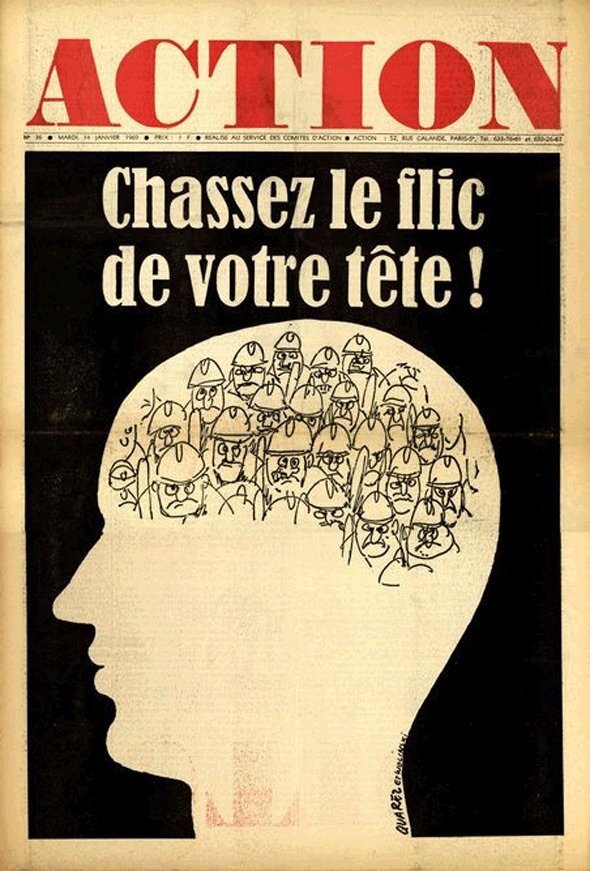
Cover from ACTION
The student protests that began in Paris in 1968, which subsequently exploded into one of the largest strikes and demonstrations in Western history, coincided with the emergence of the TV as a household object. We shouldn’t be surprised, therefore, that May ’68 lives on in its visuals: people marching in the street—at its height some 10 million across France—barricades, protest signs, graffiti, rocks hurled at the police.
May ’68 haunts us the way only an image can, lodged in the vast terrain between our conscious and subconscious. We are forever unsure what it means. Thus at the level of the conscious, we debate it: May ’68 was an event, certainly, but was it a singular moment of singular politics, a common moment of mass delusion, simply a part of a lengthy history of protest, a horrendous mistake, or, finally, a great crack in the sky? Despite our uncertainty, or perhaps because of it, we see May ’68 everywhere. It appears unbeckoned, the image in our mind for any moment of popular protest. Future movements are considered in relation to it: Was Occupy another ’68 moment? Was 2020? Were the Gilets Jaunes? These movements appear to us as a series of generation-loss xeroxes of one rowdy summer almost 60 years ago.
Theory takes a turn after May ’68, haunted by the event’s almost divine unpredictability. Disillusionment with party politics begins to grow among members of the ultra-left after the French Communist Party’s cowardly betrayal of the protestors. Those of us who are students of political theory and revolution think about May ’68 as a point of focus for a series of diverging intellectual trends in the sodden road of post-Marxism: scientific Althusserianism and romantic Rancièrian pronouncements; blasé Badiouians and fragile followers of Luc Ferry; sinister Situationists and bastardized Boltanskians.
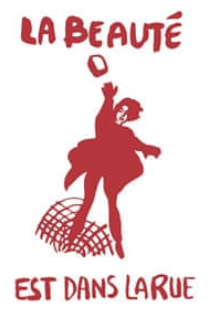
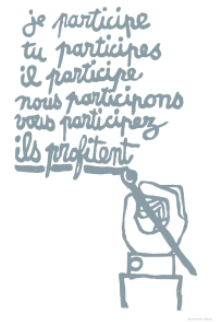
As evidenced by the frequency with which they adorn the covers of books about, and only obliquely about, May ’68, posters created during the event are a well-known aspect of its memory. Nonetheless, they are an under-theorized part of its imaginal space. I possessed this lacuna until only recently, when I attended the exhibition Paris May ’68 Revolt: The Struggle Continues at the Wardlow II International Centre for Moving Image in Melbourne. The collection of posters—which belongs to Ian Thompson, author of Synths, Saxs and Situationists: The French Musical Underground 1968-1978—posed a peculiar question: what is the role of visual language in political action?
By way of national context, the events of May ’68 coincided with a rise in TV ownership in France. In 1958, only 7% of homes owned a TV — by 1968, 62% did. Despite this growth there was only one main TV channel, run by the Office de radiodiffusion-télévision française (ORTF), a state agency that administered the radio channels, too. Given the limited media landscape, the creation of the posters then served a heightened function in the unfolding ideological struggle as an effective alternative means of mass communication.
Initially the posters were made by students of the École des Beaux-Arts, who codified themselves with the name Atelier Populaire. They produced their first posters using lithography, but this method resulted in no more than 30 a day. As the protests grew, the protestors shifted towards screen printing, seeking out assistance from those with the necessary equipment and technical knowledge. With screen printing it was possible to make around 2,000 posters a day. The most popular items—the ones that people talked about, that they wanted copies of––were produced in volume with offset printing at a nearby printshop. There, students collaborated with striking printers in a collective spirit that defined much of May ’68.
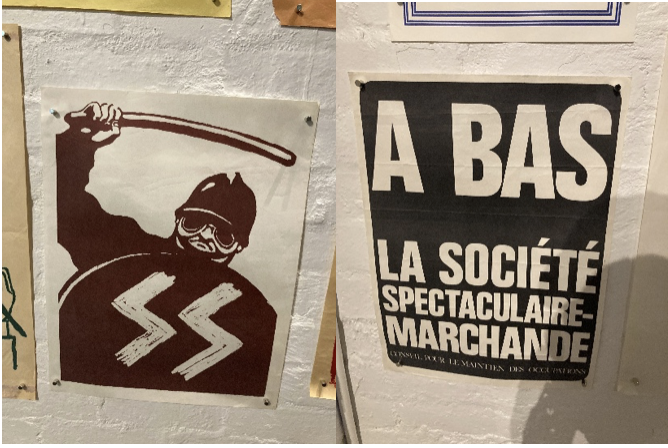
One of the more famous posters depicts a police officer, truncheon raised and ready to strike, his riot shield adorned with the well-known runic SS. The poster echoes the chants of “CRS SS!” common during May ’68. The CRS are the Compagnies républicaines de sécurité, the French police’s riot squad. It is little surprise the ominous pseudo-militaristic riot squad is found in so many posters from the event: the end of their truncheons were the first point at which state repression became reality.
In conversation with the depicted club is the motif of the streets, la rue. The obvious reading is of the masses who gathered there. A second reading can be found, too, in the protestor’s use of cobblestones as their primary weapon against the police, torn from the pavement and hurled at the head of an unsuspecting CRS lackey. Beneath the street the beach, indeed.
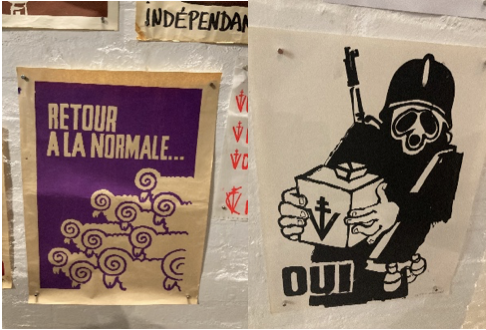
One hallmark of ’68 was collaboration between striking workers and protesting students. In addition to student artists and screen printers, this companionship also included student protestors and workers. This “local fusion,” as Badiou described it, was crucial to the protestors’ success in cutting across sociological and class lines, even if it’s important not to romanticize the disagreements and bickering the parties encountered. Indeed, the affective hallmark of a new political moment is the disintegration of the sociological, the evaporation of our place positions. Maurice Brinton, the pen name for a British socialist who was in Paris for two weeks at the height of May ’68, captured the feeling well in a piece he wrote for the British group Solidarity:
Within a matter of days the tremendous creative potentialities of the people suddenly erupted. The boldest and most realistic ideas - and they are usually the same - were advocated, argued, applied. Language, rendered stale by decades of bureaucratic mumbo-jumbo, eviscerated by those who manipulate it for advertizing purposes, suddenly reappeared as something new and fresh…. Magnificently apposite and poetic slogans emerged from the anonymous crowd. Children explained to their elders what the function of education should be…. Within a few days, young people of twenty attained a level of understanding and a political and tactical sense which many who had been in the revolutionary movement for thirty years or more were still sadly lacking.
Alongside the disruption of place positions (“children explained to their elders”) Brinton highlights the revitalization of language and slogans. What the posters represent is this revitalization at the level of visual language. It should come as no surprise that the Atelier Populaire described their posters as “weapons in the service of the struggle” whose rightful place was in the streets and on the walls of a factory. Against the overwhelming inertia of a single state-owned media company and their slogans, the posters reconfigured the visual spaces and narratives around the upheaval, filling the street with the images of the people, not the state.
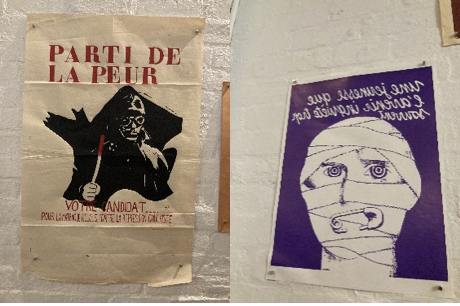
We still live with this idea of the power that comes from a flood of images. In our digitized lives, the basic act of protest is imaginal: to record and share and distribute footage and propaganda via our smartphones. It is tempting to see the posters as progenitors of this tactic. Beneath the street, black squares on Instagram. There is, I think, an important distinction to be made, one that singles out where the power of these posters in fact lies.
In 1966 the Situationists published a pamphlet entitled On the Poverty of Student Life: A Consideration of Its Economic, Political, Sexual, Psychological and Notably Intellectual Aspects and of a Few Ways to Cure It and distributed it to students at the University of Strasbourg. One year later, Guy Debord’s The Society of the Spectacle came out. Together, these documents established lines of critique that built steam toward 1968. In the former, students are chastised for accepting their role as members of the “university-factory” whose sole purpose is to prepare them for the workforce. In Debord’s text, the author declares that our social relations are now mediated by images, an experience he defines as the spectacle itself.
At the end of The Society of the Spectacle Debord declares that self-emancipation from the society of the spectacle is a collective process. Similarly, On the Poverty of Student Life holds the notion that “since the student is a product of modern society just like Godard or Coca-Cola, his extreme alienation can only be fought through the struggle against this whole society.” In other words, one cannot struggle alone.
One of the posters above, with the words “A BAS” at the top, was distributed by the Situationist International. It reads “Down with Spectacular-Market Society”. The poster is the visual against the visual, and while much can be made of its lack of aesthetic bombast, let’s not fool ourselves. Sleek minimalist boldness does not make for inherent anti-capitalism. Just look at a can of Coca-Cola. Another factor is essential to the process: collectivity. The Atelier Populaire theorized this explicitly when they set out their collaborative methodology: “How is the work carried out? Projects for posters worked out in common after a political analysis of the day's events or after discussions at the factory gates are democratically proposed in General Assembly at the end of the day.”
The May ’68 posters are monuments to the visual weapons of those who, however briefly, revolted against the system. They underscore something vital: to battle against one world of images with another image requires that we not just battle on the terrain of that image, but to do so collectively. The street is the space where the politics of the city planner rule, but this dominion can be overturned via collective processes, from production to distribution. The May ’68 posters, with their creators’ tendencies to abolish place position and demonstrate equality, provide us with a model that might someday lead toward self-emancipation, however softly our footfall lands.
Duncan Stuart is an Australian writer living in NYC. He is an editor at Fracture Magazine, and his work has appeared in the Sydney Review of Books, the Cleveland Review of Books, Jacobin, and elsewhere.